Pulished on Sep. 29, 2026
For many European forklift distributors, buying a standard electric forklift is only the first step.
Once the business grows, customers begin to recognize your company rather than the factory behind the machine. At that point, selling forklifts under your own brand starts to make sense.
A logo is easy.
Building a forklift range that customers can recognize, technicians can service and your sales team can confidently sell is more complicated.
That is where electric forklift OEM & ODM cooperation becomes important.
European distributors sourcing electric forklifts from China can use OEM and ODM manufacturing to create products for their own markets, from relatively simple private labeling to deeper changes in battery configuration, mast, tires, attachments and other specifications.
But there is a large difference between putting a sticker on ten forklifts and developing a product line you expect to sell for the next five years.
This guide explains what distributors should consider before starting an OEM or ODM electric forklift project.
OEM stands for Original Equipment Manufacturer.
In forklift procurement practice, OEM generally refers to factories building their standard forklift models and adjusting selected details for distributors or brand owners.
The basic forklift platform normally remains unchanged.
Customization may include:
l Distributor logo
l Brand name
l Model labels
l Body color
l Battery configuration
l Fork dimensions
l Mast options
l Tires
l Attachments
l Manuals
l Packaging
For many dealers, this is enough.
You do not necessarily need to redesign a forklift to build your own brand. If the existing platform already suits your customers, changing the right commercial and technical details can be a much more economical route.
ODM generally involves a greater level of product adaptation.
The manufacturer starts from an existing platform or design capability and develops a configuration more specifically around the distributor's requirements.
The exact meaning varies between manufacturers, so this is something worth discussing clearly.
One factory may describe changing a battery and mast as ODM. Another may reserve the term for more substantial engineering changes.
For a distributor, the terminology is less important than the result.
Ask exactly:
What can be changed?
What cannot be changed?
What is the minimum quantity?
What engineering or tooling cost is involved?
Will the change affect documentation, testing, spare parts or lead time?
Those answers tell you much more than the letters “OEM & ODM” on a supplier's website.
Area | OEM | ODM |
Existing Forklift Platform | Usually retained | May be more extensively adapted |
Private Logo | Yes | Yes |
Custom Color | Usually available | Usually available |
Model Labels | Yes | Yes |
Battery Options | Depending on model | Greater project flexibility |
Mast/Fork Options | Common | Can involve deeper changes |
Attachments | Common | Application-specific development possible |
Development Time | Usually shorter | Usually longer |
Engineering Input | Lower | Higher |
Best For | Dealers building a private label | Distributors requiring a differentiated product |
In practice, many European distributors begin with OEM.
It is faster, less complicated and easier to test in the market.
ODM becomes more interesting after sales volumes grow or when local customers have requirements that standard models cannot satisfy.
A common pitfall is kicking off an OEM project with talks about paint colors and logo dimensions.
These details do matter, yet they should be handled at a later stage.
Start with your customers.
If most of your customers operate small warehouses, a compact 1.5 ton or 2 ton electric forklift may be more important than offering a large range of high-capacity trucks.
If your customers are manufacturers, builders' merchants or industrial companies, 2.5 ton, 3 ton or 3.5 ton models may be more useful.
Look at what you already sell.
Which capacities receive the most inquiries?
Which lift heights are common?
Do customers ask for lithium batteries?
How often do they need side shift?
Do they work indoors, outdoors or both?
A successful private-label forklift range should reflect real local demand rather than everything the factory happens to manufacture.
It is tempting to launch ten models at once.
For a new OEM relationship, that can create unnecessary complexity.
Consider starting with a smaller core range.
For example:
1.6 Ton Compact Electric Forklift
For lighter warehouse work and restricted spaces.
2.0 Ton Electric Forklift
For general warehouse and factory applications.
2.5 Ton Electric Forklift
A useful middle capacity for broader industrial use.
3.0 Ton Electric Forklift
For customers handling heavier pallets.
Once the market response is clear, additional capacities and configurations can be added.
A smaller range also makes spare-parts stocking, technician training and marketing easier.
Private labeling needs consistency.
Do not decide the logo position separately on every order.
Create a simple branding standard.
For example, decide how your logo will appear on:
l Mast
l Counterweight
l Side panels
l Battery cover
l Model plate
l Packaging
l Manuals
Specify the dimensions and artwork format.
If you have preferred brand colors, provide references rather than saying “dark green” or “European blue.”
The same applies to model names.
If your first 2 ton forklift is called EF20, make sure the next shipment uses the same naming system.
Small inconsistencies make a product range look less professional.
For distributors building a long-term brand, this is worth getting right from the first container.
Battery choice should not be treated as an afterthought.
For many European customers, the battery is now one of the first specifications they ask about.
A lithium electric forklift may be attractive for customers who want fast charging, opportunity charging and lower routine maintenance.
Lead-acid can still suit businesses where the initial investment is more important and the forklift has plenty of time for conventional charging.
For OEM projects, distributors should agree on standard battery configurations for each model.
For example, you may have:
Standard version: suitable for normal single-shift use.
Long-runtime version: larger battery for customers operating longer hours.
This makes quotations easier for your sales team and reduces the number of unusual configurations you need to support.
For lithium batteries, also confirm the BMS, charger, warranty and replacement availability.
A larger battery can look impressive in a brochure.
It also adds cost and weight.
If your typical customer operates a forklift for three or four hours per day, the largest possible battery may not offer much commercial benefit.
Ask the manufacturer to match battery capacity to actual working conditions.
For high-use warehouses, a larger lithium configuration may be justified.
For lighter applications, a standard battery can keep your private-label forklift competitively priced.
OEM should improve the product-market fit, not simply make the specification sheet longer.
Lift height is another area where distributors can easily create too many variations.
You may receive requests for 3,000 mm, 3,500 mm, 4,500 mm, 5,000 mm and higher.
You do not necessarily need to keep every configuration in stock.
Choose a standard mast that covers most of your market, then offer other mast heights as order options.
Also consider overall mast height.
This becomes important for low doors, containers and warehouses with restricted overhead clearance.
For higher lifting applications, check the residual capacity rather than assuming the forklift retains its full rated load at every height.
Attachments are one of the more useful areas of OEM/ODM customization because they solve specific customer problems.
Options may include:
l Side shift
l Fork positioner
l Longer forks
l Paper roll clamp
l Bale clamp
l Carton clamp
l Other application-specific attachments
But attachments affect more than appearance.
They add weight and can change the load center, which may reduce the forklift's remaining capacity.
If a customer needs to handle a 2 ton load with a heavy clamp, do not simply order a 2 ton forklift and add the attachment.
Give the manufacturer the actual load weight, dimensions and working height so the complete configuration can be checked.
When distributors compare electric forklifts, many machines look similar from the outside.
Operator experience can help differentiate them.
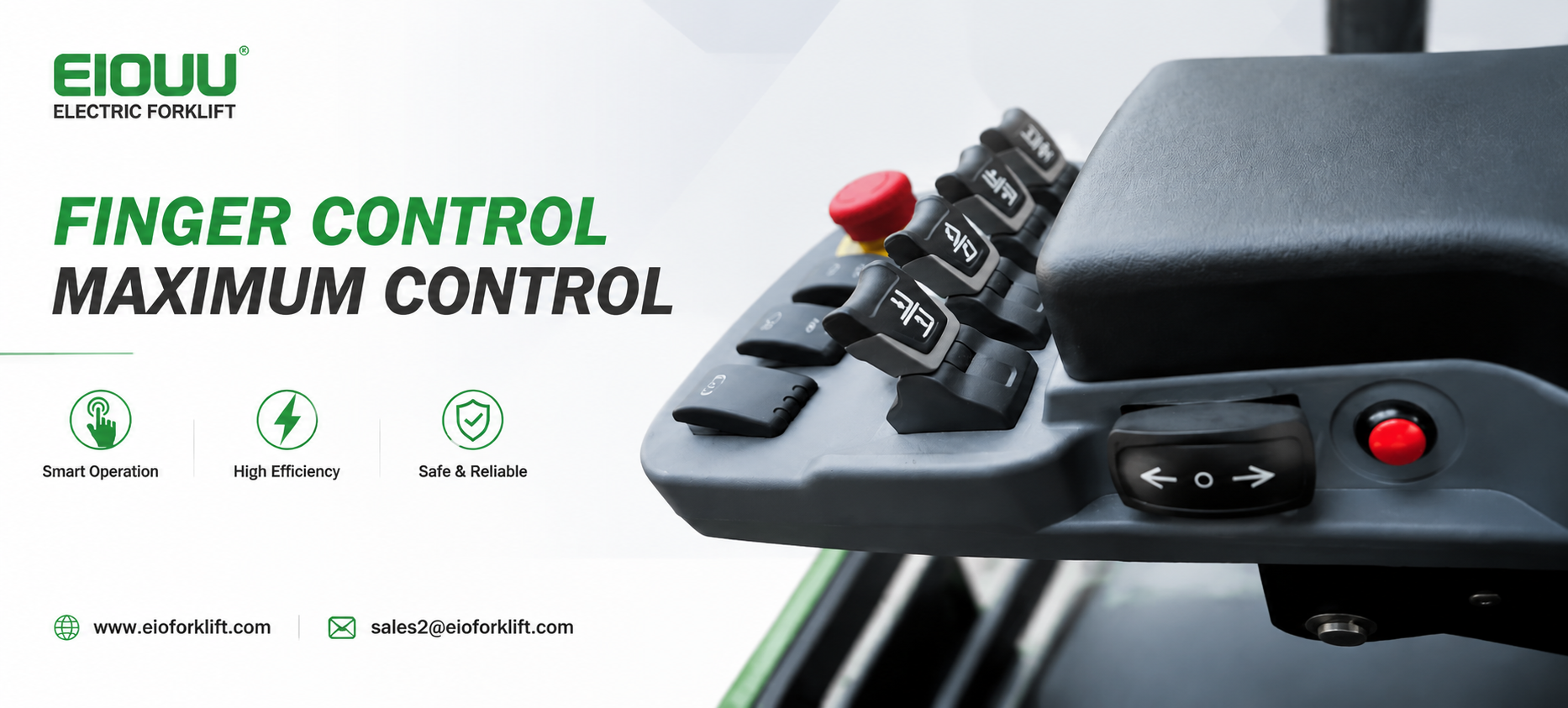
Fingertip hydraulic controls, for example, allow lift, lower and other hydraulic functions to be controlled with smaller finger movements instead of traditional large mechanical lever movements.
For operators carrying out repetitive pallet handling, this can make the control area feel cleaner and more convenient.
If you plan to position your private-label range above the lowest-price segment, details such as controls, seat design, instrumentation, damping and electrical protection deserve attention.
Customers may not ask about every feature in the first phone call.
They notice them when they drive the machine.
Not every customer wants the same forklift.
Some buy almost entirely on price.
Others care more about operator comfort, battery performance, components and long-term reliability.
For distributors, it can make sense to define different configurations rather than trying to make one forklift serve every customer.
For example:
Standard Configuration
Focused on practical daily operation and competitive pricing.
Premium Configuration
Focused on improved components, operator experience, battery management and more demanding applications.
The important thing is to make the difference clear.
Do not sell two almost identical forklifts at very different prices without explaining what the customer is paying for.
A well-designed product hierarchy can also make OEM branding much stronger.
MOQ, or minimum order quantity, varies depending on what you want to customize.
Adding a logo may be possible at relatively low volumes.
Changing body panels, molds, structural components or developing a special system may require a much larger commitment.
Ask the manufacturer early:
What is the MOQ for logo customization?
What is the MOQ for custom color?
What is the MOQ for this technical modification?
Are there additional tooling or engineering charges?
This prevents both sides from spending weeks developing a configuration that does not make commercial sense at your expected volume.
If your logo is on the forklift, your customer will expect you to support it.
That means spare parts should be planned before the first machines are sold.
Ask the manufacturer for a recommended parts list for each core model.
Your first shipment might include a small stock of common items such as sensors, switches, seals, wheels or other service components relevant to the model.
More importantly, create a way to identify parts later.
A dealer should be able to send a model number, serial number or photograph and receive the correct part information.
If the factory changes an important component in later production, the distributor should know.
Parts compatibility becomes much easier when product configurations remain consistent.
For European distributors, manuals, warnings, machine markings and other documentation should be discussed as part of the project.
Language requirements may differ depending on where the forklift will be sold.
Do not wait until the forklifts are finished to discover that a manual, label or document needs to be changed.
For private-label equipment, decide clearly which information uses your brand and which information must identify the manufacturer or other responsible economic operator as required.
The exact regulatory requirements depend on the market and equipment, so they should be reviewed for the intended destination.
OEM branding does not remove the need for proper product information and compliance.
This is especially important when a standard forklift is modified.
Changing a logo is very different from changing a major technical system.
A new mast, battery configuration, attachment or structural modification may affect technical documentation, risk assessment or other conformity considerations.
Before approving an ODM change, ask:
Does this modification affect existing testing or documentation?
What documents will be supplied with the modified machine?
Who is responsible for the technical changes?
For equipment intended for the European market, do not treat compliance as a sticker added after production.
It should be part of the product-development conversation.
For a new private-label project, a sample or trial order is valuable.
Check the forklift as both a buyer and a customer.
Look at:
l Logo position
l Paint finish
l Model labels
l Forklift dimensions
l Battery
l Charger
l Mast
l Forks
l Controls
l Attachments
l Documentation
l Packaging
Then drive it.
Lift a realistic load.
Let your technician inspect it.
If possible, let one or two customers test it.
The feedback from a real machine is usually more useful than another month of discussing specifications by email.
Once the sample is approved, create a final specification for that model.
This document becomes the reference for repeat orders.
It should identify the agreed battery, charger, mast, forks, tires, main components, color, branding and accessories.
This matters because supply chains change.
A component available this year may be replaced next year.
That is normal, but the distributor should know when an important specification changes.
A private-label product becomes difficult to support if every shipment contains different components.
Consistency is one of the foundations of a successful OEM forklift program.
When you sell another manufacturer's brand, customers may associate a product problem with that manufacturer.
When your own logo is on the counterweight, the situation changes.
The customer sees your forklift.
That makes pre-shipment quality control particularly important.
For larger OEM orders, establish an inspection checklist covering the agreed specification and basic functions.
Check branding as carefully as mechanical items.
Twenty forklifts arriving with the wrong model label will still work, but it creates unnecessary work for the distributor.
The best place to correct production mistakes is usually before the container leaves the factory.
OEM projects often involve several models.
A distributor might order 1.6 ton, 2 ton, 2.5 ton and 3 ton forklifts in one shipment.
Ask the manufacturer to prepare a loading plan before production is complete.
A solid loading layout boosts container usage and cuts per-unit shipping expenses.
You should also confirm whether any components get taken off for shipping and which parts need assembly after delivery.
Packaging should protect both the machine and your finished branding.
A damaged logo or scratched counterweight is not a good first impression when the customer sees your new brand for the first time.
A forklift OEM project does not finish when the container is loaded.
In many ways, that is when the real test starts.
Can the manufacturer answer technical questions?
Can it identify an error code?
Can it supply a replacement component?
Can it provide wiring or parts information to your technician?
Can it support the same model several years later?
European distributors should evaluate this before scaling up.
A supplier that is excellent at producing private labels but weak at after-sales support can create problems as the installed fleet grows.
The more forklifts you sell, the more important technical support becomes.
At EIOUU, we work with international B2B customers including forklift dealers, wholesalers, importers and industrial equipment companies.
Our OEM & ODM approach can begin with existing electric forklift platforms and then be configured according to the distributor's market and project requirements.
Depending on the model and order, this can include discussions around:
l Private branding
l Product colors
l Lithium battery configurations
l Mast options
l Fork dimensions
l Tires
l Attachments
l Operator controls
l Product labels
l Packaging
For distributors building their own forklift brand, we believe the less visible parts of the project are just as important.
Product consistency matters.
Spare parts matter.
Battery and component information matters.
And communication after delivery matters.
Our goal is not simply to put another company's logo on an electric forklift. It is to help B2B customers develop a product configuration they can continue selling and supporting in their own market.
A good electric forklift OEM & ODM project should solve a business problem.
Maybe you need a compact lithium forklift for European warehouses.
Maybe your customers want a higher-specification model than the products currently available in your market.
Maybe you already sell forklifts successfully and now want to build your own brand.
Whatever the reason, start with the application and customer.
Then decide the capacity, battery, mast, controls, attachments and service strategy.
Branding comes after that.
A logo can be printed in a few minutes.
A forklift range that customers trust takes much longer to build.
For European distributors planning a long-term private-label business, that difference is worth remembering.
OEM electric forklift manufacturing usually means producing an existing forklift platform with agreed customization for a distributor, such as private branding, colors, labels, battery options, masts, forks or attachments.
OEM generally uses an existing forklift design with selected customization. ODM can involve deeper product adaptation or development according to a distributor's requirements. The exact scope varies between manufacturers and should be confirmed before ordering.
Yes, many electric forklift manufacturers provide private-label services for distributors. Logo position, colors, model labels, packaging and other branding details should be agreed before production.
Battery configurations may be selectable depending on the forklift platform and manufacturer. Buyers should consider working hours, charging requirements, BMS, charger compatibility, warranty and future replacement availability rather than choosing battery capacity only by size.
There is no universal MOQ. Simple logo customization may be possible at relatively low quantities, while custom colors, structural changes or ODM development may require larger orders. Buyers should confirm MOQ for each requested modification.
Check the forklift platform, battery system, required customization, documentation, applicable compliance requirements, spare-parts support, warranty, quality-control process, MOQ, production lead time and long-term product consistency.
EIOUU supports OEM & ODM discussions for international B2B customers. Available customization depends on the forklift model, order quantity and technical requirements, and can include branding and selected product configurations for the target market.
 Previous: None
Electric Forklift OEM & ODM Guide for European Distributors
Published on Sep. 29, 2026
How to Choose a Reliable Electric Forklift Manufacturer in China
Published on Sep. 25, 2026


314, Building 3, No. 12 Haitai Development 2nd Road, Binhai High-tech Zone, Xiqing District, Tianjin, China


Copyright © Tianjin HRX Technology Co., Ltd. All Rights Reserved. Sitemap
Home ProductsAbout usOEM/ODMNewsContact Us