Pulished on Oct. 14, 2026
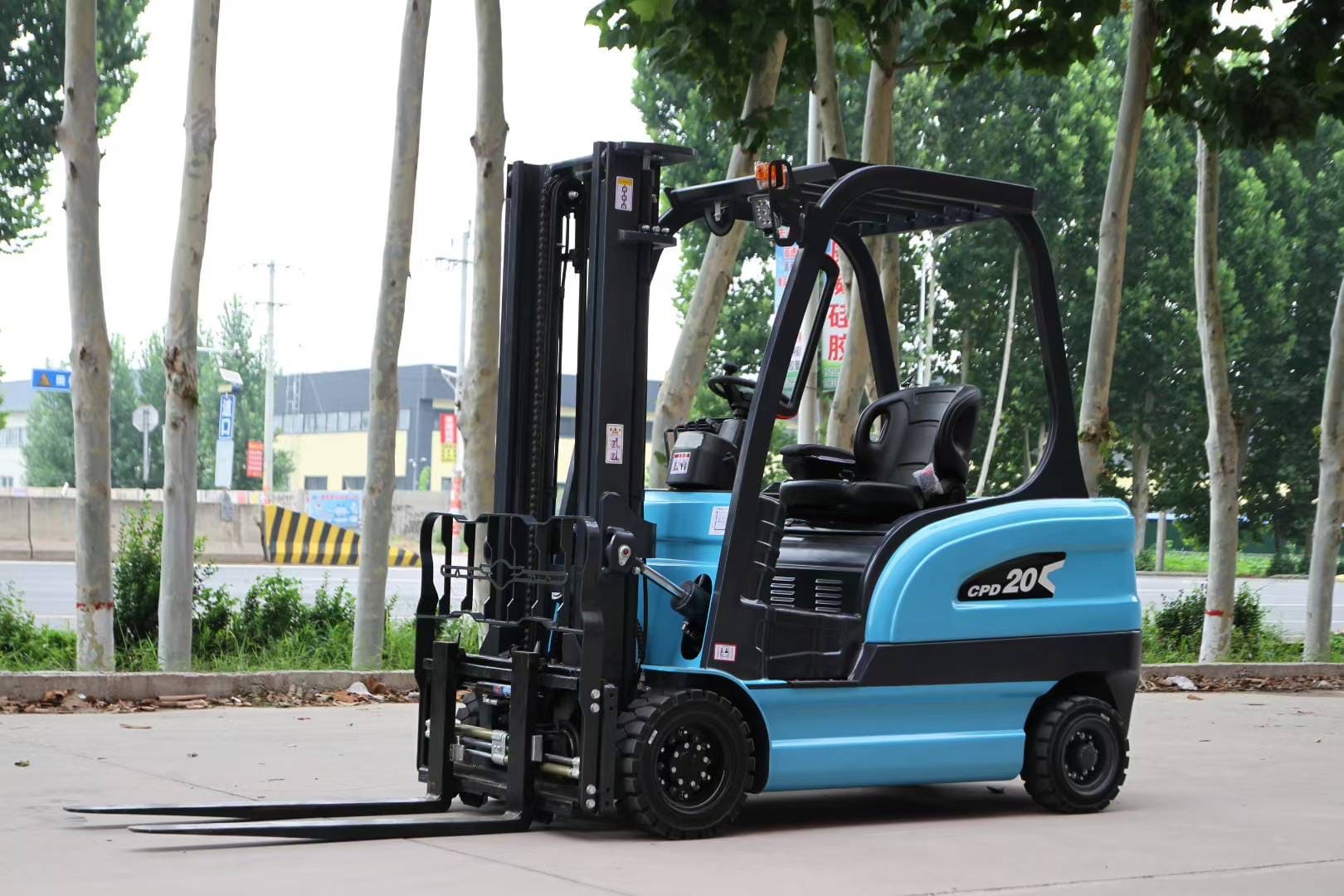
A 2 ton electric forklift is one of those machines that fits a surprisingly wide range of jobs.
It is small enough for many warehouses, yet it has more capacity in reserve than lighter 1.5 ton models. For factories, logistics companies and distributors, that makes the 2,000 kg class an attractive middle ground.
But “2 ton” tells you only one thing about a forklift.
Two machines with the same rated capacity can have different dimensions, batteries, mast configurations, turning radii, controls and components. One may work perfectly in a compact warehouse. The other may be better suited to longer shifts or heavier industrial use.
This is why buying on capacity and price alone often leads to the wrong comparison.
If you are considering a 2 ton electric forklift for a warehouse, or adding one to your dealership's product range, here are the details worth checking before placing an order.
A 2 ton electric forklift is a battery-powered counterbalanced forklift with a nominal rated load capacity of 2,000 kg, subject to the manufacturer's specified load center and operating conditions.
Unlike diesel or LPG forklifts, electric models use a battery and electric drive system.
Common applications include:
l Warehouse pallet handling
l Factory material movement
l Production lines
l Distribution centers
l Logistics operations
l Loading and unloading
l Indoor storage
l Light and medium industrial applications
A 2 ton model is often chosen by businesses that need more flexibility than a compact 1.5 ton forklift but do not require the size and capacity of a 3 ton machine.
Start with the load.
Not the forklift.
If your normal pallets weigh 800–1,200 kg and the heaviest load is around 1,500 kg, a 2 ton forklift may provide a comfortable capacity range.
If your normal loads are already close to 2,000 kg, the decision needs more attention.
Rated capacity is based on specified conditions.
The actual load a forklift can handle can be affected by the load center, lift height, mast and attachments.
A long load moves the center of gravity farther forward.
A heavy attachment adds weight in front of the truck.
Higher lift heights may also affect available capacity.
So instead of telling the supplier:
“We need a 2 ton forklift.”
Tell them:
“Our maximum load is 1,750 kg, pallet size is 1,200 × 1,000 mm, and maximum lift height is 4,500 mm.”
That gives the manufacturer something useful to check.
The appeal of a 2 ton electric forklift is balance.
Many warehouse operators do not need a large industrial truck. They need something that can handle normal pallet loads without taking up unnecessary space.
A properly selected 2 ton model can work well around:
l Storage racks
l Loading bays
l Production areas
l Packing stations
l Narrower warehouse routes
Electric drive is also well suited to many indoor environments because there are no tailpipe exhaust emissions at the point of use and operating noise is generally lower than with comparable internal combustion forklifts.
For a warehouse with people working close to the machine throughout the day, that can be a practical advantage.
This is where buyers should stop looking at the marketing brochure and open the specification sheet.
Measure:
Overall length
Overall width
Wheelbase
Turning radius
Required stacking aisle width
A few hundred millimeters can make a noticeable difference inside a warehouse.
If the truck frequently turns between racks, a compact wheelbase can be valuable.
If it needs to pass through doors, overall width matters.
And if the warehouse already has fixed rack spacing, the required aisle width should be checked before the order—not when the forklift arrives.
For tight applications, send the supplier a warehouse layout with measurements.
A forklift does not work alone.
It works with a load.
A truck may fit comfortably into an aisle when empty but require considerably more room when carrying a 1,200 mm pallet.
Check the pallet size and entry direction.
Also look at the space available at the end of the aisle.
If your warehouse handles several pallet types, give the supplier those dimensions too when you discuss the forklift..
This is especially useful for European distributors whose customers may use Euro pallets alongside other industrial pallet sizes.
A standard mast may be enough for one warehouse and completely unsuitable for another.
Measure the highest rack position the forklift needs to serve.
If your required lift height is 3,000 mm, tell the supplier.
If it is 4,500 or 5,000 mm, say so before asking for a final price.
Higher lift height can affect mast configuration and available capacity.
You should also check the mast height when lowered.
This matters when the forklift must pass through:
l Warehouse doors
l Containers
l Loading bays
l Low ceilings
l Height-restricted production areas
Do not select the mast from maximum lift height alone.
Depending on the model and application, buyers may have different mast options.
A duplex mast can be suitable for many standard lifting applications.
A triplex mast may be useful when greater lift height is required while keeping the closed mast height relatively controlled.
There is no reason to pay for a more complex mast if the warehouse does not need it.
On the other hand, ordering the wrong mast to save money can limit where the forklift is able to work.
Give the manufacturer the rack height and lowest overhead clearance.
Let those two measurements guide the choice.
Battery selection has a major influence on how a 2 ton electric forklift works during the day.
For many modern warehouses, a 2 ton lithium electric forklift is an attractive option.
Lithium batteries can offer:
l Faster charging
l Opportunity charging
l Lower routine battery maintenance
l Good suitability for frequent daily operation
For example, a warehouse running the forklift throughout the day may charge it during lunch or other suitable breaks.
Lead-acid batteries remain relevant too.
If the forklift works only a few hours per day and can be charged overnight, the lower initial purchase cost of lead-acid may make sense.
Don’t pick a battery just because it is newer.
Choose based on the working schedule.
This is another area where bigger does not automatically mean better.
Battery capacity should reflect the actual duty cycle.
Ask:
How many hours does the forklift operate?
How much of that time is spent driving?
How often does it lift?
What is the average load?
Are there slopes?
How far does it travel?
A 2 ton forklift moving 800 kg pallets around a small warehouse has a very different energy requirement from one continuously handling 1,800 kg loads.
A suitable battery configuration can keep the purchase price under control without compromising the required working time.
When purchasing a lithium forklift, look beyond battery capacity.
The Battery Management System (BMS) is an important part of the battery system.
Depending on the design, it can monitor operating parameters such as voltage, current, temperature and state of charge while providing protection under specified abnormal conditions.
Also ask whether the battery, BMS, charger and forklift control system are properly integrated.
A lithium battery should be evaluated as part of the complete forklift, not as a separate box fitted after the truck was designed.
A good battery with the wrong charging arrangement creates an unnecessary problem.
Confirm:
l Charger specification
l Compatibility with the battery
l Charging requirements
l Intended electrical supply
l Plug/configuration where applicable
For distributors importing forklifts, put the agreed charger specification on the purchase order.
Do not simply write “EU charger.”
Details are better than assumptions.
Hydraulic controls affect the operator every time a pallet is lifted.
Traditional mechanical levers are simple and familiar.
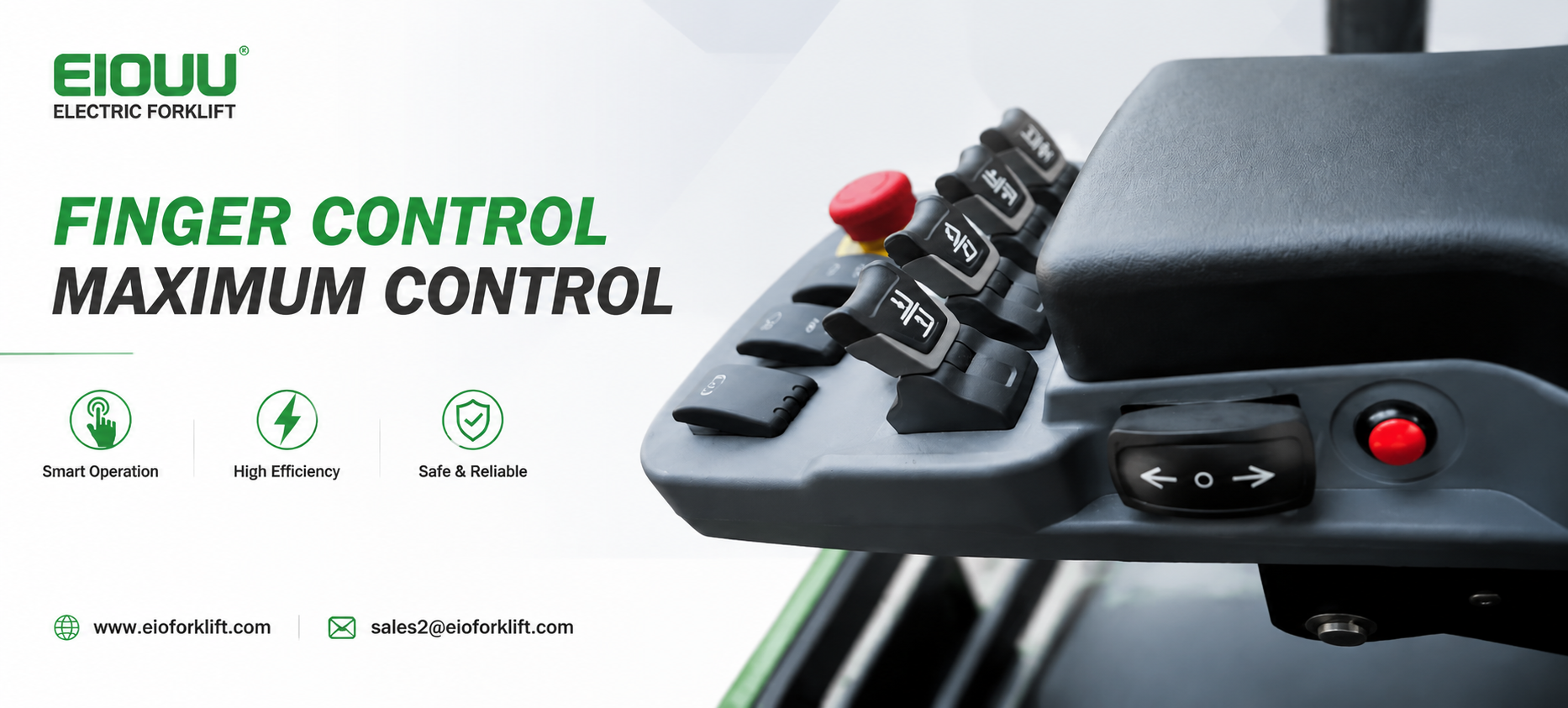
Fingertip controls provide another option, allowing hydraulic functions to be operated with smaller finger movements.
For warehouses where operators repeatedly lift, lower and position pallets throughout a shift, this can make the operating area feel cleaner and more convenient.
For distributors, fingertip control can also help differentiate a higher-specification electric forklift from basic price-focused machines.
The important thing is how the controls feel in real use.
If possible, test them.
A forklift is not only its battery.
Mechanical construction still matters.
When comparing suppliers, look at:
l Front axle
l Mast structure
l Hydraulic cylinders
l Overhead guard
l Steering system
l Brake system
l Frame construction
Ask for detailed photographs.
Better still, ask for a video of the actual model lifting a realistic load.
At EIOUU, applicable electric forklift configurations can include features such as a one-piece cast steel axle, reinforced mast design, anti-leakage cylinder structure and rear axle damping.
These details are less exciting than a large touchscreen in a brochure.
After a few years of daily work, they can matter considerably more.
Open the electrical compartment.
Look at the wiring.
Are cables routed neatly?
Are connectors protected?
Can technicians access important components?
For forklifts working around warehouses, factories and loading areas, electrical protection should be considered as part of long-term reliability.
EIOUU electric forklift configurations can include automotive-grade wiring arrangements and protection of electrical components according to the model.
For distributors, knowing the internal component layout also makes future servicing easier.
Tire selection depends on where the forklift works.
A machine operating entirely on smooth warehouse floors has different requirements from one regularly moving into an outdoor loading area.
Consider:
l Floor surface
l Outdoor use
l Wear
l Operator comfort
l Ground conditions
l Cleanliness requirements
If your customers have specific requirements, discuss tire options with the manufacturer rather than accepting the default configuration automatically.
For some buyers, tire material and floor marking are becoming part of the purchasing discussion.
Depending on the available model and tire specification, suitable tire options can help meet requirements for cleaner indoor operation or particular warehouse environments.
The important point is to confirm the actual tire specification rather than relying on a broad marketing description such as “eco tire.”
For distributors, this is also useful when creating different product configurations for different customer groups.
For many warehouse applications, yes.
A side shift allows the operator to move the forks laterally without repositioning the entire forklift.
When placing pallets into racks, that can save small corrections.
Those small corrections happen many times per day.
For general warehouse use, side shift is therefore a popular option.
But it is still an attachment.
Its weight and effect on load center should be considered when checking the forklift's remaining capacity.
A 2 ton electric forklift can potentially work with various attachments depending on the model and application.
These may include:
l Fork positioner
l Bale clamp
l Carton clamp
l Paper roll clamp
l Longer forks
Do not pick the forklift first and then add the attachment without checking capacity.
Say a customer needs to handle a load close to 2,000 kg with a heavy clamp. A higher-capacity forklift may be needed in that case.
Send the manufacturer the attachment type, load weight, load dimensions and lift height before confirming the model.
A 2 ton electric forklift is often associated with indoor warehouse use, but many models can also handle suitable outdoor applications.
The important word is suitable.
Smooth outdoor concrete is very different from broken ground.
Check:
l Surface condition
l Gradients
l Rain exposure
l Temperature
l Travel distance
l Tire requirements
If the forklift regularly moves between indoor and outdoor areas, tell the supplier.
This can influence the recommended configuration.
Daily operating time affects several purchasing decisions.
A forklift working two hours per day may not need the same battery or specification as a machine working eight hours.
For intensive applications, pay more attention to:
l Battery configuration
l Charging
l Operator comfort
l Controls
l Component quality
l Maintenance access
l Spare parts
The longer the forklift works, the more valuable these details become.
This is one reason distributors should avoid selling every customer the same “standard” configuration.
A 2 ton model is usually the more logical choice when loads remain comfortably below its operating limits and compact dimensions matter.
A 3 ton forklift becomes more attractive when the customer regularly handles heavier loads, needs greater capacity reserve or works with attachments that affect remaining capacity.
Do not assume that “more capacity is safer” and buy a 3 ton forklift on that basis.
The larger machine may cost more, use more energy and take up more space.
Equally, do not choose a 2 ton model simply to save money when the application regularly pushes it close to its limit.
Match the truck to the job.
Before buying a 2 ton electric forklift, collect these details:
1. Maximum load weight
2. Load dimensions
3. Load center
4. Required lift height
5. Lowest overhead clearance
6. Aisle width
7. Pallet dimensions
8. Daily working hours
9. Indoor/outdoor conditions
10. Battery preference
11. Tire requirements
12. Required attachments
Send this information with your inquiry.
You will receive a more useful quotation.
Distributors have another set of questions.
You are not only buying a forklift.
You are buying something you may need to support for years.
Check:
Can the manufacturer keep the specification consistent?
Can spare parts be identified later?
Is technical information available?
What happens during a warranty claim?
Can OEM branding be repeated consistently?
Can different battery and mast configurations be supplied?
A forklift that is easy to buy but difficult to support is not a good distributor product.
Do not wait until a customer's machine stops.
Ask for a recommended spare-parts list with the first order.
Depending on the model, useful local stock may include common:
l Sensors
l Switches
l Hydraulic seals
l Wheels
l Brake components
l Electrical parts
l Charger-related parts
l Other service components
The individual cost of these parts can be small.
The cost of waiting for them can be much larger.
The 2 ton class can be a useful core model for a private-label forklift range.
Depending on manufacturer capability, OEM electric forklift options can include:
l Distributor logo
l Product colors
l Model labels
l Lithium battery configurations
l Mast options
l Fork dimensions
l Tires
l Attachments
l Packaging
For a distributor, consistency matters more than offering unlimited customization.
A customer who buys another 2 ton forklift two years later should receive a machine that still feels like the same product family.
At EIOUU, we manufacture electric material handling equipment for international B2B customers, including forklift dealers, wholesalers, importers, warehouses and industrial buyers.
Our 2 ton electric forklift solutions are intended for warehouse, factory and logistics applications where buyers need a balance of capacity, maneuverability and electric operation.
Depending on the model and project requirements, available configurations can include options such as:
l Lithium battery
l Compact body design
l Fingertip controls
l Different mast configurations
l Fork options
l Tire options
l Intelligent BMS battery management
l Operator-presence protection
l Rear axle damping
l Energy-recovery braking
l OEM & ODM solutions
For distributors, branding and product configurations can be discussed according to the target market and order requirements.
If you are not sure which configuration is suitable, send us the maximum load, pallet dimensions, lift height, daily working hours and aisle width.
Those five details are a much better starting point than price alone.
A 2 ton electric forklift is a versatile machine.
That is exactly why there are so many versions of it.
Do not choose one because the brochure says 2,000 kg and the price looks good.
Look at what your warehouse actually does.
Measure the aisle.
Check the load.
Check the rack.
Think about the battery.
Decide whether the operator needs fingertip controls.
Consider side shift.
And ask how spare parts will be supplied after the forklift has been working for several years.
For distributors, add one more question:
Would I be comfortable putting my own name on this machine?
If the answer is yes after checking the product, components and support, you are probably looking at a much better purchasing decision.
A 2 ton electric forklift has a nominal rated capacity of 2,000 kg under specified conditions. Actual available capacity can be affected by load center, lift height, mast configuration and attachments.
Yes. The 2 ton class is widely suited to warehouse, factory and logistics applications where loads fall within the machine's capacity and the forklift dimensions match the working area.
Lithium can be a good choice for frequent use, opportunity charging and lower routine battery maintenance. Lead-acid may still suit lighter-duty operations where initial purchase cost is more important.
Choose lift height according to your warehouse rack system. Also check the mast's closed height and the forklift's remaining capacity at the required lift height.
Neither is automatically better. A 2 ton model can be more compact and economical, while a 3 ton forklift provides more capacity. The correct choice depends on the actual load, attachments, lift height and working environment.
Fingertip controls can make repeated hydraulic operations more convenient by allowing functions to be controlled with smaller finger movements. Their value is greatest in applications involving frequent pallet positioning.
Many 2 ton forklifts can be configured with side shift. Because attachments can affect remaining capacity and load center, the complete configuration should be confirmed before ordering.
Yes, depending on the manufacturer, model and order requirements. OEM options can include private branding, colors, battery configurations, mast options, forks, tires and attachments.
2 ton 3 point electric forklift
 Previous: None
2 Ton Electric Forklift Buying Guide for Warehouses and Distributors
Published on Oct. 14, 2026
1.5 Ton Electric Forklift: Is It Right for Your Warehouse?
Published on Oct. 10, 2026


314, Building 3, No. 12 Haitai Development 2nd Road, Binhai High-tech Zone, Xiqing District, Tianjin, China


Copyright © Tianjin HRX Technology Co., Ltd. All Rights Reserved. Sitemap
Home ProductsAbout usOEM/ODMNewsContact Us