Pulished on Oct. 16, 2026
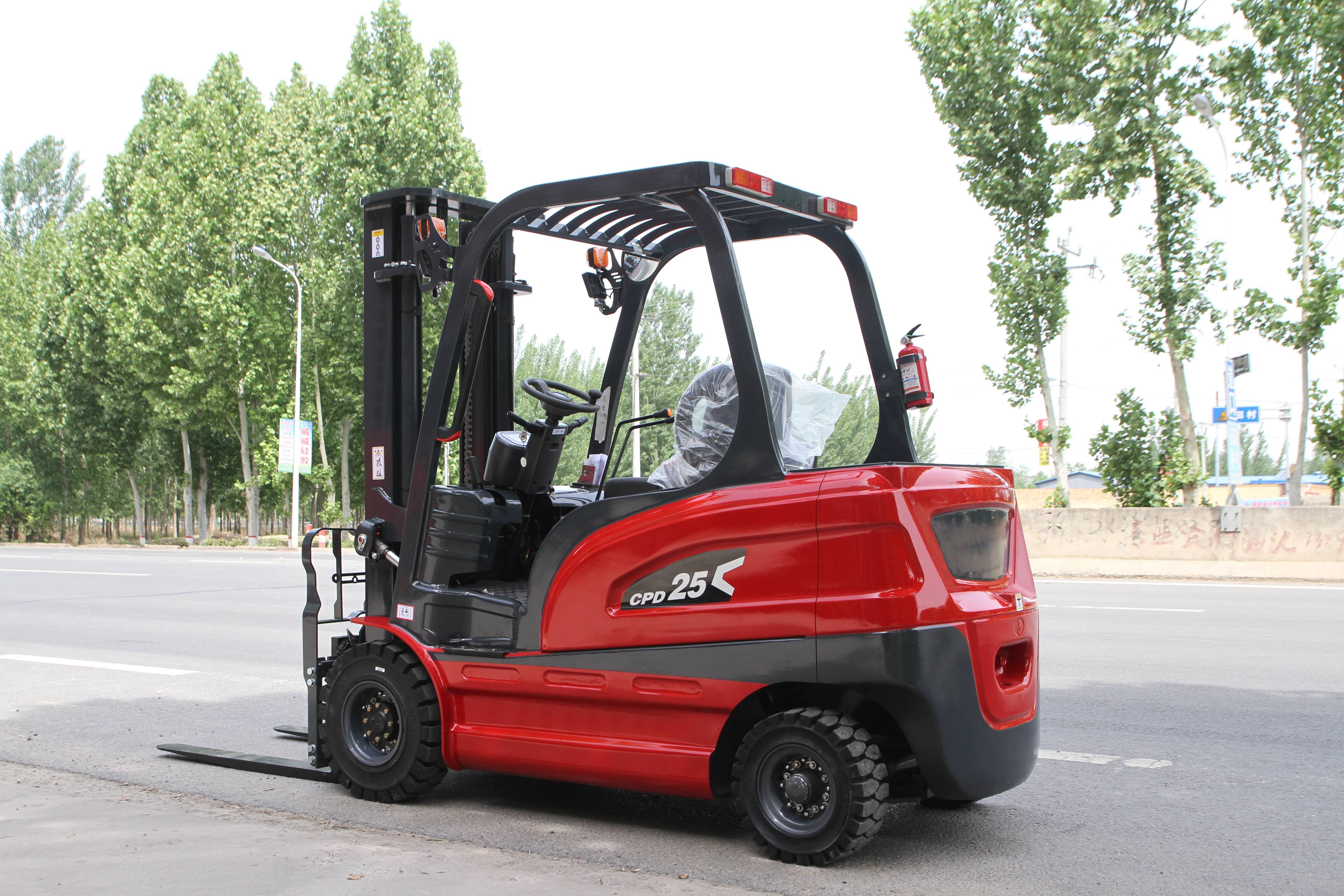
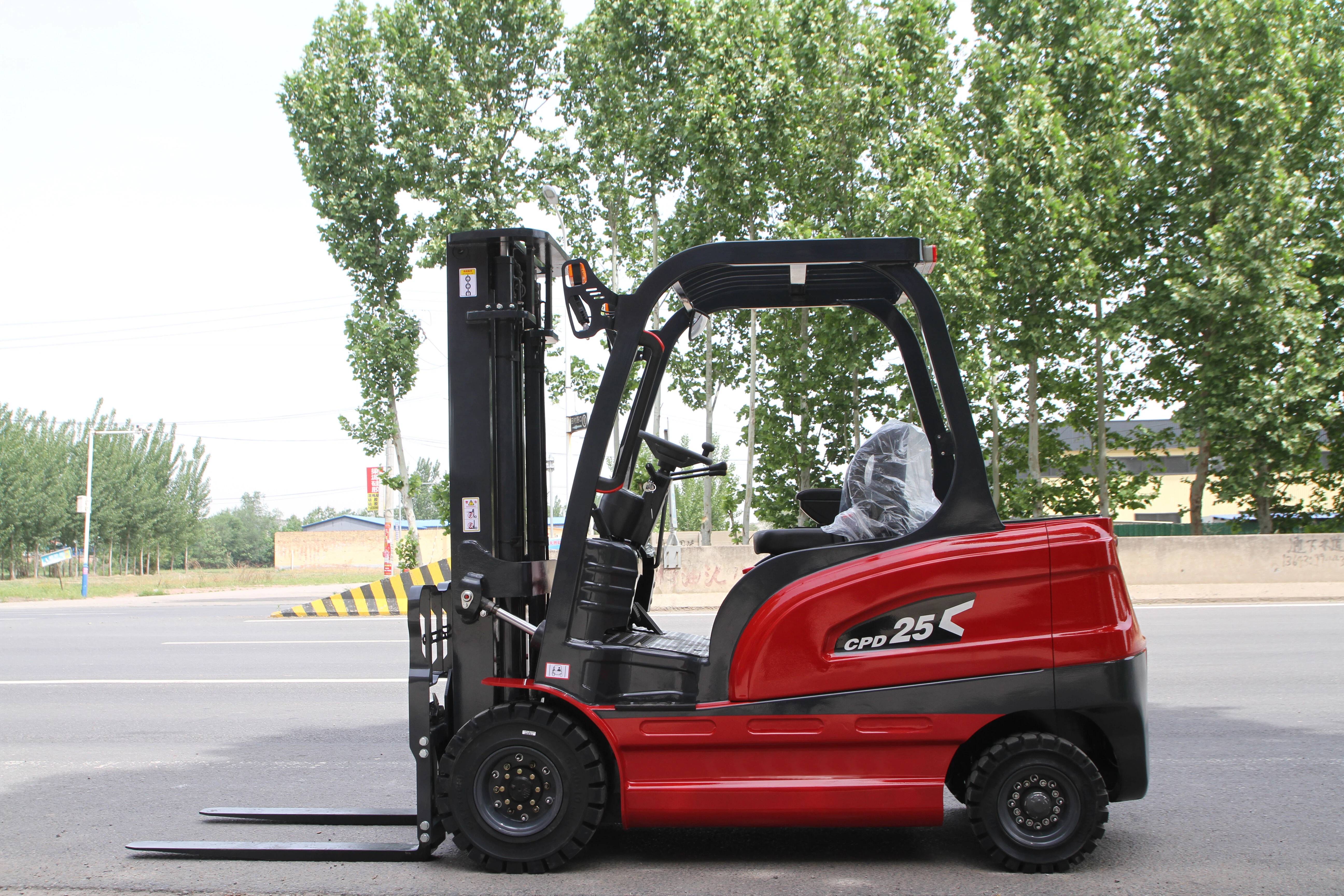
A 2.5 ton electric forklift often sits in the sweet spot between a standard warehouse truck and a heavier industrial forklift.
It lifts more than a 2-ton model, without the bulk and weight of a 3-ton unit. The extra 500 kg capacity suits warehouses, factories and logistics sites with variable pallet weights.
Even so, capacity alone is not enough to justify your purchase.
A poorly chosen battery stops the 2.5-ton truck from handling daily work. An unsuitable mast may block it from standard warehouse doorways. When heavy attachments are fitted, real fork capacity falls below your expected rating.
So before you compare prices, start with the job.
What are you lifting? How high? How often? Where will the forklift operate?
Once those questions are answered, choosing the right 2.5 ton electric forklift becomes much easier.
A 2.5 ton electric forklift is a battery-powered counterbalanced forklift with a nominal rated capacity of 2,500 kg under the conditions specified by the manufacturer.
It can be used for a wide range of material handling jobs, including:
l Warehouse pallet handling
l Manufacturing plants
l Production lines
l Logistics centers
l Distribution warehouses
l Loading and unloading
l Industrial storage
l Indoor and suitable outdoor applications
The 2.5 ton class is particularly useful for businesses whose loads are too close to the limits of a 2 ton forklift but do not regularly require a full 3 ton capacity.
That makes it an interesting model for both end users and forklift distributors.
Not necessarily.
The 2,500 kg rated capacity is based on specified conditions, including load center.
A long load shifts the center of gravity farther from the forklift. Lift to greater heights, and the mast may change how much capacity is actually available.
Attachments also matter.
A side shift, fork positioner, bale clamp or paper roll clamp adds weight to the front of the forklift and may change the effective load center.
For this reason, do not choose a forklift simply because:
“Our heaviest product weighs 2.4 tons.”
Instead, provide:
Maximum load weight
Load dimensions
Load center if known
Required lift height
Attachment type
The manufacturer can then check whether the proposed configuration is suitable.
A 2.5-ton unit is a good pick if a 2-ton forklift runs too near its regular working limit.
Take a manufacturer dealing with loads ranging from 1,400 to 2,100 kg as an example.
A 2-ton truck can handle most of the workload yet offers very little room for heavier pallets.
A 3-ton unit can manage these weights, but the company may have no real use for its extra bulk, higher price and surplus lifting capacity.
That is exactly where a 2.5-ton model works out nicely.
It provides additional capacity without unnecessarily moving too far above the actual requirement.
Typical users include:
l Machinery manufacturers
l Warehouses
l Automotive suppliers
l Logistics businesses
l Metalworking companies
l Building material suppliers
l Packaging operations
l Industrial distributors
The actual suitability still depends on the forklift design and working environment.
There is a difference between being within capacity and choosing a machine that is comfortable for the job.
Running a forklift near its maximum rated capacity for most shifts leaves minimal room for shifting pallet weights, load sizes or added attachments.
A sensible capacity buffer brings greater operational flexibility for businesses.
You don’t need a 3.5-ton forklift for every job carrying 1,800 kg loads.
Going too big comes with downsides too.
Bigger forklifts carry higher costs, take up extra floor space and consume more power.
The goal is not maximum capacity.
The goal is appropriate capacity.
If most loads are below 1,500 kg, a 2 ton electric forklift may already be enough.
The move to 2.5 tons becomes more attractive when:
l Loads frequently exceed 1,800–2,000 kg
l Pallet weights vary
l Longer loads are common
l Attachments are required
l The business wants more capacity flexibility
l Future products may be heavier
Warehouse space should also be considered.
If your 2.5-ton forklift is far bulkier than the 2-ton variant, that higher load rating will hurt its turning ability.
Look at the machine’s overall dimensions directly; don’t just guess the size difference is trivial.
The same question appears at the other end.
Should you move from 2.5 to 3 tons?
A 3 ton forklift makes more sense when loads regularly approach or exceed the practical limits of the 2.5 ton configuration.
It can also provide more flexibility for heavy attachments and industrial applications.
A 2.5 ton forklift, however, may offer a better balance for businesses that rarely need the full 3,000 kg capacity.
A simple way to think about it is:
Requirement | 2.0 Ton | 2.5 Ton | 3.0 Ton |
Rated Capacity | 2,000 kg | 2,500 kg | 3,000 kg |
General Warehouse Use | Excellent | Excellent | Good |
Heavier Pallets | Limited | Very Good | Excellent |
Maneuverability | Generally better | Balanced | Generally needs more space |
Capacity Flexibility | Moderate | High | Very High |
Purchase Cost | Lower | Mid-range | Higher |
Industrial Applications | Good | Very Good | Excellent |
These are general differences. Actual truck dimensions and performance vary by model.
Battery selection is one of the biggest decisions when specifying a 2.5 ton electric forklift.
The first question should not be:
“What is the biggest battery available?”
Ask instead:
“How many hours will the forklift actually work?”
A truck used for two hours each morning has a very different requirement from one moving pallets throughout an eight-hour shift.
Consider:
l Daily operating hours
l Average load
l Travel distance
l Number of lifts
l Lift height
l Charging opportunities
l Multi-shift operation
l Gradients
Once the duty cycle is understood, battery selection becomes much more sensible.
For many applications, a 2.5 ton lithium electric forklift can be an attractive configuration.
Lithium batteries bring several practical upsides: fast charging, opportunity charging, and lower day-to-day battery maintenance.
This feature comes in handy for busy, high-volume warehouse sites.
A forklift can run all morning, top-up its battery during staff breaks, and get back to work right after.
This minimizes the requirement for extended charging time during working shifts.
Lithium batteries also eliminate the regular water topping needed for conventional flooded lead-acid batteries.
For distributors selling to customers with longer working schedules, these are practical benefits that are relatively easy to explain.
Lithium batteries are now widely available, yet lead-acid is far from obsolete.
It still offers a practical, cost-effective option for light-duty work.
Take a factory that only runs a single forklift for three hours each day.
The truck finishes its afternoon shift, leaving the whole night available for charging.
Under such conditions, fast opportunity charging brings little value to offset the higher upfront cost of lithium batteries.
The most suitable battery matches your site’s operation and budget.
That’s why reliable suppliers will first ask about operating hours, instead of recommending one battery type by default.
For lithium systems, look at the complete battery package.
Ask about:
l Voltage
l Capacity
l Battery chemistry
l BMS
l Charger
l Charging time
l Warranty
l Replacement availability
The Battery Management System (BMS) is particularly important because it monitors and manages key battery operating conditions according to the system design.
Battery, charger, BMS and forklift control system should work together.
A large battery from an unknown source is not automatically better than a properly integrated system with a more appropriate capacity.
Most forklifts support 3-meter lift heights, yet warehouse layouts differ from site to site.
Take measurements and record the max height of your racking.
If pallets require placement at 4.5m, inform your supplier of the load weight at this height.
Also measure the lowest doorway or overhead restriction.
This is where mast configuration becomes important.
A forklift may reach the required rack but have a closed mast height that causes problems elsewhere in the building.
For buyers, two measurements are therefore important:
maximum required fork height
and
maximum allowable closed mast height.
You can’t assume a 2.5 ton forklift lifts the full 2,500 kg at all mast heights.
Residual capacity shifts as lift height rises or when attachments are mounted.
Where customers often lift heavy pallets onto high rack levels, obtain capacity data matching the machine’s actual build.
This is especially important for distributors.
Never promise a customer a capacity at height based only on the large “2.5 TON” number in the brochure.
A 2.5 ton electric forklift needs enough room to work.
Before ordering, check:
l Overall length
l Overall width
l Wheelbase
l Turning radius
l Fork length
l Stacking aisle requirement
A compact design can make a noticeable difference in busy warehouses.
The operator may turn and reposition the forklift hundreds of times during a shift.
Tiny space gains from each handling cycle build up significantly.
Share your real-world warehouse measurements with suppliers when you have narrow aisles.
Warehouse buyers often focus on lifting.
But forklifts also travel.
Longer 100-meter cargo trips between production and storage make ride performance and operator comfort key considerations.
Where travel distances stay short, just a few meters from staging to racks, your main focus points change.
Longer travel distances increase the importance of:
l Battery capacity
l Operator seating
l Acceleration
l Braking
l Steering
l Vibration
l Tire choice
The same 2.5 ton forklift is not ideal for every duty cycle.
Regular hydraulic levers perform reliably for everyday site work.
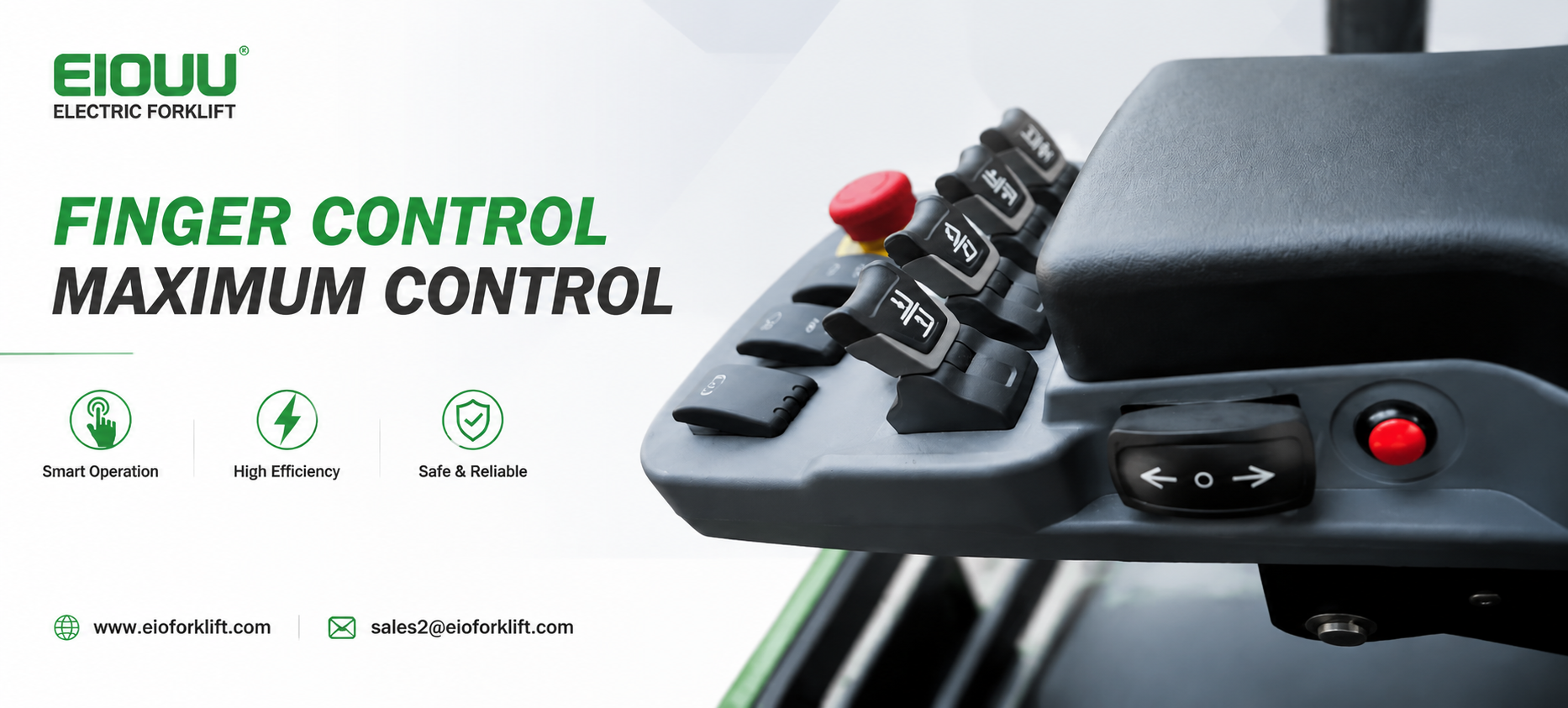
For repetitive material handling, fingertip controls can offer a more compact operating arrangement.
Workers only need slight finger motions to run all hydraulic functions, so they don’t have to shift big mechanical levers over and over.
Warehouses and factories handling pallets nonstop will benefit most from this configuration.
For distributors, fingertip controls act as a visible feature to distinguish high-spec forklifts from simple base-level machines.
Not every user will actually require this feature.
Still, operators can pick up on the difference right away once they get behind the wheel.
Electric forklifts are often marketed around batteries.
The forklift still has a mast, axle, hydraulic system, brakes and steering system.
These parts matter.
Ask the supplier about:
l Axle construction
l Mast structure
l Hydraulic cylinders
l Overhead guard
l Steering
l Braking
l Frame
l Service access
At EIOUU, selected electric forklift configurations can include features such as a one-piece cast steel axle, reinforced mast construction, anti-leakage cylinder design and rear axle damping.
These are not features that necessarily look impressive in a search result.
They become more relevant after the machine has spent several years moving heavy pallets.
Tires chosen for a forklift on smooth indoor concrete differ from those fitted on machines used often in outdoor yards.
Tell the supplier about:
l Floor surface
l Outdoor use
l Door thresholds
l Uneven ground
l Cleanliness requirements
l Expected working hours
Forklift models come with different tire setups to pick from.
If you operate indoors and need to avoid floor scuffs or meet environmental rules, talk to your supplier about tire choices that fit these needs.
For general warehouse work, side shift is often a useful option.
It allows the operator to move the forks sideways when positioning a pallet instead of repeatedly moving the whole truck.
The time saved on one pallet may be small.
Across hundreds of pallet movements, it becomes more noticeable.
However, side shift adds weight.
Like other attachments, it should be considered when checking residual capacity.
If your loads already approach 2,500 kg, confirm the complete configuration before ordering.
The 2.5 ton class can also be used for more specialized material handling, depending on the forklift and attachment.
Applications may involve:
l Bale clamps
l Carton clamps
l Fork positioners
l Longer forks
l Other customized attachments
When using heavy attachments, don’t match forklift rated capacity merely to load weight.
A 2,400 kg load plus an attachment may not fit a 2.5 ton forklift.
Share load dimensions, weight, lift height and attachment details with the manufacturer.
You may need a 3 ton or 3.5 ton model instead.
Electric forklifts are widely used indoors because there are no tailpipe exhaust emissions at the point of operation and noise levels are generally lower than internal combustion trucks.
A suitable electric forklift can also work outdoors.
The key is the environment.
Smooth concrete outside a warehouse differs greatly from rough ground in construction material yards.
If your forklift runs both inside and outside, take these factors into account:
l Tire configuration
l Electrical protection
l Gradients
l Surface conditions
l Weather exposure
l Travel distance
Tell the supplier about the difficult part of the job, not just the easy part.
Safety should be evaluated as part of the complete machine.
Depending on the model, useful features can include:
l Operator-presence protection
l Controlled cargo lowering
l Clear instrument display
l LED lighting
l Braking assistance
l Speed management
l Battery monitoring
Visibility through the mast is also important.
So is how predictably the forklift responds when starting, turning and stopping.
For distributors, test the machine with an experienced operator before committing to large volumes.
A specification sheet cannot replace driving the truck.
Electric forklifts remove many engine-related maintenance items, but they still require regular inspection and service.
Check access to:
l Battery
l Controller
l Electrical components
l Hydraulic system
l Brake components
l Wheels
l Sensors
A forklift designed with reasonable service access can save technician time later.
This matters more for fleet buyers and distributors as their forklift pool expands.
Get the suggested spare parts list when placing your first commercial order.
It covers typical service parts and wear items matching your specific forklift build.
You don’t have to keep every single part in inventory.
The key is having a trustworthy channel to identify and procure parts when needed.
Reach out to the manufacturer and ask:
“If I send you the serial number and a photo of a component three years from now, can you identify the correct replacement?”
For a distributor, that question is more important than receiving a long list of free accessories.
For dealers, the 2.5 ton electric forklift fills a key market gap.
A 2 ton model covers general warehouse demand.
3 ton forklifts take on heavier workloads.
Sitting in this middle range, the 2.5 ton electric forklift works well for clients wanting higher capacity, while avoiding the step up to a bigger truck.
It can be particularly useful for:
l Manufacturing customers
l Mixed warehouse fleets
l Industrial users
l Logistics businesses
l Customers replacing internal combustion forklifts
For distributors building a private-label range, 2.5 tons can therefore be a useful core capacity rather than a niche model.
Depending on manufacturer capability and order requirements, an OEM 2.5 ton electric forklift can be configured for a distributor's market.
Options may include:
l Private logo
l Product colors
l Model labels
l Lithium battery configuration
l Mast options
l Fork dimensions
l Tires
l Side shift
l Other attachments
l Packaging
Do not customize everything just because you can.
For a distributor, a small number of stable, repeatable configurations is usually easier to sell and support than dozens of one-off specifications.
Instead of writing:
“Need 2.5T lithium forklift, send best price.”
Try:
Maximum load: 2,100 kg
Pallet: 1,200 × 1,000 mm
Lift height: 3,500 mm
Daily use: 7 hours
Environment: Indoor + outdoor concrete
Battery: Lithium
Attachment: Side shift
Quantity: 5 units
That one message can save several rounds of questions.
It also makes quotations from different suppliers easier to compare.
At EIOUU, we manufacture electric material handling equipment for international B2B customers, including forklift dealers, wholesalers, importers, warehouses and industrial buyers.
Our electric forklift range includes solutions for different capacities and working environments.
For 2.5 ton applications, configurations can be discussed according to actual load, lift height, working time and customer requirements.
Depending on the model and project, options can include features such as:
l Lithium battery
l Fingertip controls
l Compact design
l Different mast configurations
l Tire options
l Side shift and other attachments
l Intelligent BMS battery management
l Operator-presence protection
l One-piece cast steel axle
l Anti-leakage cylinder design
l Rear axle damping
l Energy-recovery braking
Distributors and importers can look into OEM & ODM cooperation to build private brands and tailor units for target markets.
If you’re weighing 2 ton, 2.5 ton or 3 ton electric forklifts, share load weight, cargo size, lift height requirement and operating site details.
It’s better to pick capacity according to your actual work scenario instead of merely referencing the price list.
A 2.5t electric forklift isn’t merely a 2-ton machine that gets an extra 500kg on its spec sheet.
It works well as a middle option for sites with matching workloads.
It copes with heavier warehouse and factory goods, so you won’t need to upgrade to a larger forklift straight away.
But the capacity badge is only the beginning.
Check the load center.
Check the lift height.
Head to your warehouse and take measurements yourself.
Keep daily running hours of the forklift in consideration.
Choose the battery around that schedule.
Consider the attachment before confirming capacity.
And ask how the machine will be supported after delivery.
For many warehouses, 2.5 tons will be exactly the right middle ground.
For others, 2 tons is enough.
And if the work regularly pushes a 2.5 ton truck close to its limits, a 3 ton model may be the smarter purchase.
The right answer comes from the job—not from the number printed on the brochure.
A 2.5 ton electric forklift has a 2,500 kg nominal rating, valid only under standard conditions. Load center, lift height, mast setup and attachments all change its usable capacity.
Yes. It works well in warehouses with medium or heavier pallet loads, as long as its dimensions, lift height and capacity fit your site.
A 2 ton unit handles light loads and brings advantages in cost and compact size. A 2.5 ton forklift delivers extra capacity for heavier or mixed loads.
Choose 3 tons when heavier loads, attachments or future applications require more capacity. If loads remain comfortably within the 2.5 ton configuration, the smaller truck may provide a better balance of capacity, size and cost.
Yes. Lithium batteries can be well suited to 2.5 ton electric forklifts, especially in applications requiring frequent operation, opportunity charging and lower routine battery maintenance.
Working time depends on battery capacity, load weight, travel distance, lifting frequency, lift height, floor conditions and operating style. You need to select the battery setup based on your real duty cycle.
Most models support side shift installation. Since attachments alter overall weight and load center, always verify residual capacity for the fully built machine.
Yes, depending on the manufacturer and project. OEM options can include private branding, colors, batteries, mast configurations, forks, tires, attachments and packaging.
 Previous: None
2.5 Ton Electric Forklift Buying Guide: Capacity, Battery and Applications
Published on Oct. 16, 2026
2 Ton Electric Forklift Buying Guide for Warehouses and Distributors
Published on Oct. 14, 2026


314, Building 3, No. 12 Haitai Development 2nd Road, Binhai High-tech Zone, Xiqing District, Tianjin, China


Copyright © Tianjin HRX Technology Co., Ltd. All Rights Reserved. Sitemap
Home ProductsAbout usFor DistributorsOEM/ODMNewsContact Us