Pulished on Oct. 06, 2026
Importing an electric forklift from China is not particularly difficult.
Importing the right forklift, with the right documents, battery, charger and spare-parts support, takes more work.
For a European distributor buying a full container, small mistakes can become expensive very quickly. A battery specification that was never confirmed, an unsuitable charger or a missing document is inconvenient on one machine. Multiply the same issue across ten or twenty forklifts and it becomes a very different problem.
This is why experienced buyers normally spend more time confirming an order before production starts.
If you are planning to import electric forklifts from China to Europe, here is a practical step-by-step guide to the process.
Do not begin by sending the same message to twenty suppliers:
“Please send your best price for electric forklift.”
You will get plenty of quotations.
Comparing them will be difficult because every supplier may be quoting something slightly different.
Start with a basic requirement sheet.
At minimum, include:
l Load capacity
l Maximum load weight
l Load dimensions
l Required lift height
l Mast type if known
l Fork dimensions
l Battery preference
l Daily working hours
l Indoor or outdoor use
l Tire requirements
l Attachments
l Destination country
For example:
Capacity: 2,500 kg
Lift height: 3,000 mm
Battery: Lithium
Working time: Approximately 6 hours/day
Application: Indoor warehouse
Attachment: Side shift
Destination: Germany
This gives a manufacturer enough information to prepare a meaningful quotation.
A common mistake is buying too close to the maximum load.
If the heaviest pallet weighs 1,950 kg, a buyer may immediately choose a 2 ton electric forklift.
That might be correct.
It might not.
Forklift capacity depends on factors such as load center, lift height and attachments. A long load or heavy clamp can change the remaining capacity.
If the application is close to the forklift's rated limit, give the manufacturer the actual load dimensions and maximum lifting height.
For distributors, it can also make sense to think beyond one customer.
Popular ratings including 1.5/1.6 ton, 2 ton, 2.5 ton and 3 ton work well for most warehouse and industrial work. Heavier models, meanwhile, target customers with unique handling demands.
Battery configuration can have a significant effect on the final price and customer experience.
Lithium electric forklifts have become attractive for many warehouse applications because they can offer fast charging, opportunity charging and lower routine battery maintenance.
They can be particularly useful for customers operating forklifts for long hours.
Where the initial purchase price is a key consideration and the forklift has enough time for standard charging, lead-acid remains a sensible option.
Don’t just go by the name of the technology when picking a battery.
For lithium batteries, ask for:
l Battery voltage
l Battery capacity
l Battery chemistry
l BMS information
l Charger specification
l Approximate charging time
l Battery warranty
l Replacement availability
Most importantly, tell the supplier how many hours the forklift is expected to work.
The battery should fit the job.
There are many electric forklift suppliers in China.
A low quotation is easy to find.
A supplier capable of supporting a European distributor over several years requires more investigation.
Ask whether the company manufactures the forklift itself and where production takes place.
Request recent factory videos showing actual assembly and testing.
If you are discussing a specific 3 ton model, ask to see that model.
Look at:
l Mast production and assembly
l Axle and frame construction
l Hydraulic system
l Wiring
l Battery installation
l Testing
l Finished product storage
l Container loading
For larger purchasing programs, a factory visit or independent audit may be worthwhile.
The purpose is not to find the largest factory.
It is to understand who is responsible for the machine you are buying.
Suppose you receive three quotations:
Supplier A: $8,900
Supplier B: $9,300
Supplier C: $9,700
It is tempting to rank them immediately.
Don't.
Check whether the specifications are actually the same.
Supplier A may use a smaller battery.
Supplier B may include side shift.
Supplier C may use a different mast or higher-specification components.
Compare:
capacity + mast + battery + charger + controller + forks + tires + attachments + warranty + included accessories.
Only then compare the price.
For distributors, it is useful to create one standard specification sheet and ask several suppliers to quote against it.
This sounds like a small detail.
It can become a very annoying one after delivery.
Confirm the electrical requirements for the destination and make sure the charger supplied with the forklift is suitable for the battery and intended market.
Put the charger specification on the purchase order.
Do not rely on:
“European charger, no problem.”
If you are importing several units, check the charger label during pre-shipment inspection as well.
For equipment being imported into Europe, regulatory compliance should be considered before the order is placed.
Requirements vary by destination, equipment, configuration and the company’s role in placing the machine on the market.
Ask the manufacturer what documents come with the exact forklift model you plan to buy.
Review them before shipment.
If the machine has been customized with a different mast, battery system, attachment or other technical change, confirm whether that modification affects the relevant technical documentation or conformity assessment.
Do not treat CE marking as a sticker that can simply be requested at the end of production.
European importers and distributors must know their own obligations and check the rules for the market where the equipment will be sold.
When necessary, obtain professional compliance advice before importing.
Once you have selected the supplier, freeze the specification.
A final order sheet should clearly identify the agreed:
l Model
l Rated capacity
l Lift height
l Mast
l Battery
l Charger
l Fork dimensions
l Tires
l Side shift
l Attachments
l Color
l Branding
l Accessories
l Documentation
Photos or drawings can be added where something is easy to misunderstand.
This is particularly important for OEM orders.
“Blue forklift with our logo” is not a specification.
Provide the actual artwork, color reference, logo position and model label requirements.
Confirming details before production saves you trouble afterward.
Before comparing shipping costs, find out what the quotation covers.
Common international trade terms may include EXW, FOB, CIF and others, depending on the supplier and shipment.
For example, an FOB quotation and a CIF quotation cannot be compared directly as if they include the same services and costs.
Ask:
Where does the supplier's responsibility end?
Which transport costs are included?
Who arranges ocean freight?
Who handles insurance?
Who is responsible for destination charges?
For a first-time importer, working with an experienced freight forwarder can make the process much easier.
Payment terms vary between suppliers, order sizes and customer relationships.
Whatever terms are agreed, make sure the commercial invoice, purchase order and product specification match.
Check the beneficiary details carefully.
If bank information suddenly changes during an email conversation, verify it through a separate trusted communication channel before sending funds.
For larger orders, clear documentation and internal payment verification are worth the extra few minutes.
Do not disappear between paying the deposit and receiving a shipping notice.
Ask for production updates.
For an OEM order, request photos when branding and key configurations are completed.
This gives you a chance to catch obvious issues early.
For example:
Wrong logo position.
Wrong forklift color.
Incorrect fork length.
Different battery specification.
Missing attachment.
Finding these issues before final assembly or loading is much easier than correcting them in Europe.
Inspection is particularly useful when working with a new Chinese forklift manufacturer.
The scope can be simple or detailed depending on the order.
Check:
l Model and quantity
l Serial information
l Appearance
l Lift height
l Mast
l Forks
l Tires
l Battery
l Charger
l Attachments
l Branding
l Labels
l Accessories
l Basic driving functions
l Steering
l Braking
l Hydraulic operation
l Lights
l Documentation
If possible, test at least some machines with a realistic load.
For larger commercial orders, a third-party inspection can provide an additional level of control.
Lithium batteries require particular attention during international transport.
If your forklifts use lithium batteries, talk to the manufacturer and freight forwarder about shipping requirements early on.
Find out what battery transport documents are needed for that particular shipment, and how the battery should be prepared and handled.
Do not assume a lithium forklift ships the same way as one with a lead-acid battery.
It depends on the battery configuration, how it is transported and the carrier.
An experienced exporter and freight forwarder should sort this out before the container reaches the port.
Electric forklifts take up valuable container space.
Ask the manufacturer how many machines can fit into a 20GP or 40HQ container for the models you are ordering.
Also ask:
l Will the mast remain installed?
l Will any parts be removed?
l How are the forklifts secured?
l How are accessories packed?
l How is movement prevented during transport?
l Can different models be mixed?
For a distributor testing a new product range, mixed loading can sometimes be useful.
You might import several capacities instead of filling the entire container with one model.
That gives you a chance to test local demand before holding too much inventory.
Request container loading photographs.
These are useful for more than marketing.
They provide a record of how the machines were positioned and secured before the container left the factory.
Look for adequate restraint and protection between machines.
Check that loose components and accessories are properly packed.
For OEM forklifts, make sure finished surfaces and branding are protected from transport damage.
A forklift that worked perfectly at the factory still needs to survive the journey to Europe.
Do not leave the paperwork until the vessel reaches the destination port.
Check with your customs broker or freight forwarder which documents your shipment needs.
Depending on the transaction and destination, these can include commercial and transport documents, packing information and other product-related documentation.
Classification, duties, taxes and import procedures can change and may vary according to the destination and product configuration.
For this reason, confirm the applicable HS/CN classification and current import requirements with a qualified customs professional rather than relying on an old online article or another importer's previous shipment.
This is especially important if you are importing forklifts commercially for resale.
FOB price is not your final forklift cost.
A distributor should calculate the approximate landed cost before deciding whether a product is commercially attractive.
A simple calculation is:
l Factory price
l Options and accessories
l Origin-side charges not included in the agreed Incoterm
l Ocean freight
l Insurance
l Destination charges
l Applicable duties and taxes
l Customs/broker costs
l Local transport
l Pre-delivery preparation
l Initial spare parts
= Approximate landed cost
Then add the commercial costs that appear later:
warranty work, local technician time and inventory.
This is the number that should influence your selling price and margin.
The machines were inspected before shipment.
Inspect them again after arrival.
International transport can cause damage even when loading was done correctly.
Before delivering the forklift to your customer:
l Check for transport damage
l Inspect tires and mast
l Check hydraulic components
l Inspect battery condition
l Check charger and accessories
l Test driving and braking
l Test lift and lower functions
l Confirm labels and documents
l Charge and test the machine where appropriate
This can form part of your pre-delivery inspection (PDI) process.
For distributors, PDI is a useful way to catch small issues before the customer sees the forklift.
If you are importing one forklift for your own warehouse, you may decide to order parts when necessary.
If you are importing twenty forklifts for customers, the calculation changes.
Ask the manufacturer for a recommended spare-parts package.
Keep common service and wear parts locally.
A sensor or seal may cost very little.
The expensive part is having a customer's forklift stopped while everyone waits for international shipping.
For a distributor, spare-parts availability is part of the product.
This becomes increasingly important as your installed fleet grows.
Keep a record of:
l Model
l Serial number
l Production date
l Battery configuration
l Charger
l Controller
l Mast
l Attachments
l Key components
l Parts information
If you are importing OEM forklifts under your own brand, link your private model number to the manufacturer's configuration.
Three years later, when a customer sends a photograph of a damaged component, this information can save hours of work.
Not necessarily.
If this is your first order with a manufacturer, a smaller trial order can be sensible.
It allows you to test:
the product, the supplier and your market.
See whether the specification is correct.
Let your technicians inspect the machines.
See how quickly the manufacturer responds to technical questions.
Get feedback from customers.
If the first machines perform well, increase the next order.
A slightly higher freight cost per machine on a trial order can sometimes be cheaper than discovering a product problem after importing a large batch.
Several problems appear repeatedly in international purchasing.
One is choosing entirely on price.
Another is confirming the model but not the complete specification.
Some buyers focus heavily on the forklift and forget the battery and charger.
Others review compliance documents too late.
Spare parts are often discussed only after the first problem occurs.
And for OEM orders, branding sometimes receives more attention than product consistency.
None of these problems is particularly complicated to prevent.
They simply need to be considered before shipment.
At EIOUU, we supply electric material handling equipment for international B2B customers, including forklift distributors, wholesalers, importers and industrial buyers.
Our electric forklift range covers different capacities and applications, with configurations available according to the model and project requirements.
Customers can discuss options including:
l Lithium battery configurations
l Different load capacities
l Mast options
l Fork dimensions
l Tires
l Attachments
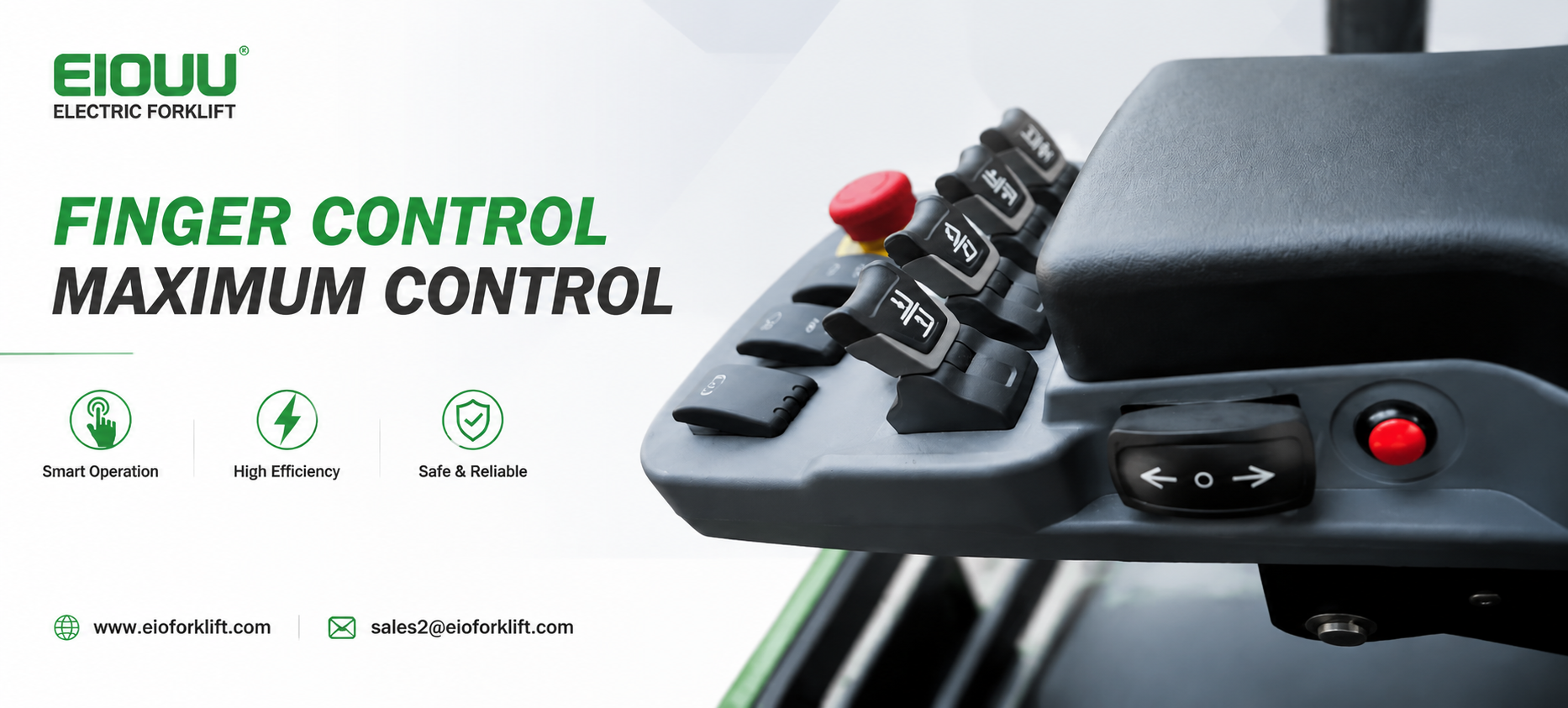
l Fingertip controls on applicable models
l OEM & ODM branding and configurations
For distributor projects, we also understand that the work does not finish when the forklift leaves the factory.
Product consistency, loading, spare-parts identification and technical communication become increasingly important as more machines enter the customer's market.
If you are planning your first electric forklift order from China, sending the load weight, lift height, daily working hours, required quantity and destination is a good place to start.
A clear requirement normally produces a much better quotation than asking for the lowest price first.
Importing electric forklifts from China to Europe is not just a shipping exercise.
Most of the important work happens before the container is loaded.
Choose the right machine.
Confirm the battery and charger.
Understand the supplier.
Review the relevant documentation and compliance requirements.
Freeze the specification.
Inspect before shipment.
Plan customs and logistics in advance.
And think about spare parts before the first forklift is sold.
The first order may take more time because everything is new.
The second should be easier.
By the third or fourth container, a good distributor and manufacturer should have a clear specification, inspection process, loading plan and parts system in place.
That is when importing stops feeling like a series of individual purchases and starts becoming a repeatable supply chain.
Yes, businesses can source electric forklifts from Chinese manufacturers for European markets, subject to the applicable product, customs, tax, transport and regulatory requirements. Importers should verify the requirements for their specific destination and equipment before shipment.
The required documents depend on the destination, transaction and forklift configuration. Commercial, transport, customs and product-compliance documentation may all be relevant. Confirm the current requirements with your freight forwarder, customs professional and, where necessary, a product-compliance specialist.
Yes, but lithium batteries require additional transport considerations. Battery configuration, documentation, packaging and carrier requirements should be confirmed with the manufacturer and freight forwarder before shipment.
It depends on forklift dimensions, mast configuration, battery arrangement and whether parts are removed for shipping. Ask the manufacturer for a loading plan for the exact models being ordered rather than relying on a general number.
There is no single best Incoterm for every importer. The right option depends on your experience, freight arrangements, destination and commercial agreement. Make sure you understand exactly which costs and responsibilities are included before comparing quotations.
For commercial orders, especially with a new supplier, pre-shipment inspection is highly recommended. It gives the buyer an opportunity to verify specifications, functions, branding, accessories and documentation before the equipment leaves the factory.
Yes. Many manufacturers provide OEM services for distributors, including private logos, colors, model labels and selected product configurations. Requirements should be agreed before production.
Compare more than price. Look at manufacturing capability, actual product specifications, batteries and components, quality control, documentation, warranty, spare-parts availability and technical support.
 Previous: None
How to Import Electric Forklifts from China to Europe
Published on Oct. 06, 2026
OEM Electric Forklifts: How Distributors Can Build Their Own Brand
Published on Oct. 04, 2026


314, Building 3, No. 12 Haitai Development 2nd Road, Binhai High-tech Zone, Xiqing District, Tianjin, China


Copyright © Tianjin HRX Technology Co., Ltd. All Rights Reserved. Sitemap
Home ProductsAbout usOEM/ODMNewsContact Us