Pulished on Oct. 01, 2026
An electric stacker can look like a fairly simple machine.
There are forks, a mast, a battery and a control handle. Choose the lifting capacity and lift height, and the job is done.
In practice, this is where many purchasing mistakes begin.
Even if two warehouses handle pallets weighing 1,000 kg, they may require totally different stacker models. One site only transfers goods between ground level and low racking. The other works within narrow aisles and regularly lifts pallets to heights of several meters. Some operations even need to transport two pallets in a single handling run.
Raw figures listed on specification sheets cannot capture all these real-world conditions.
Choosing the right electric stacker for a warehouse means looking at the load, pallet, rack, floor, aisle and daily working pattern together.
Below are the key factors to evaluate prior to purchase.
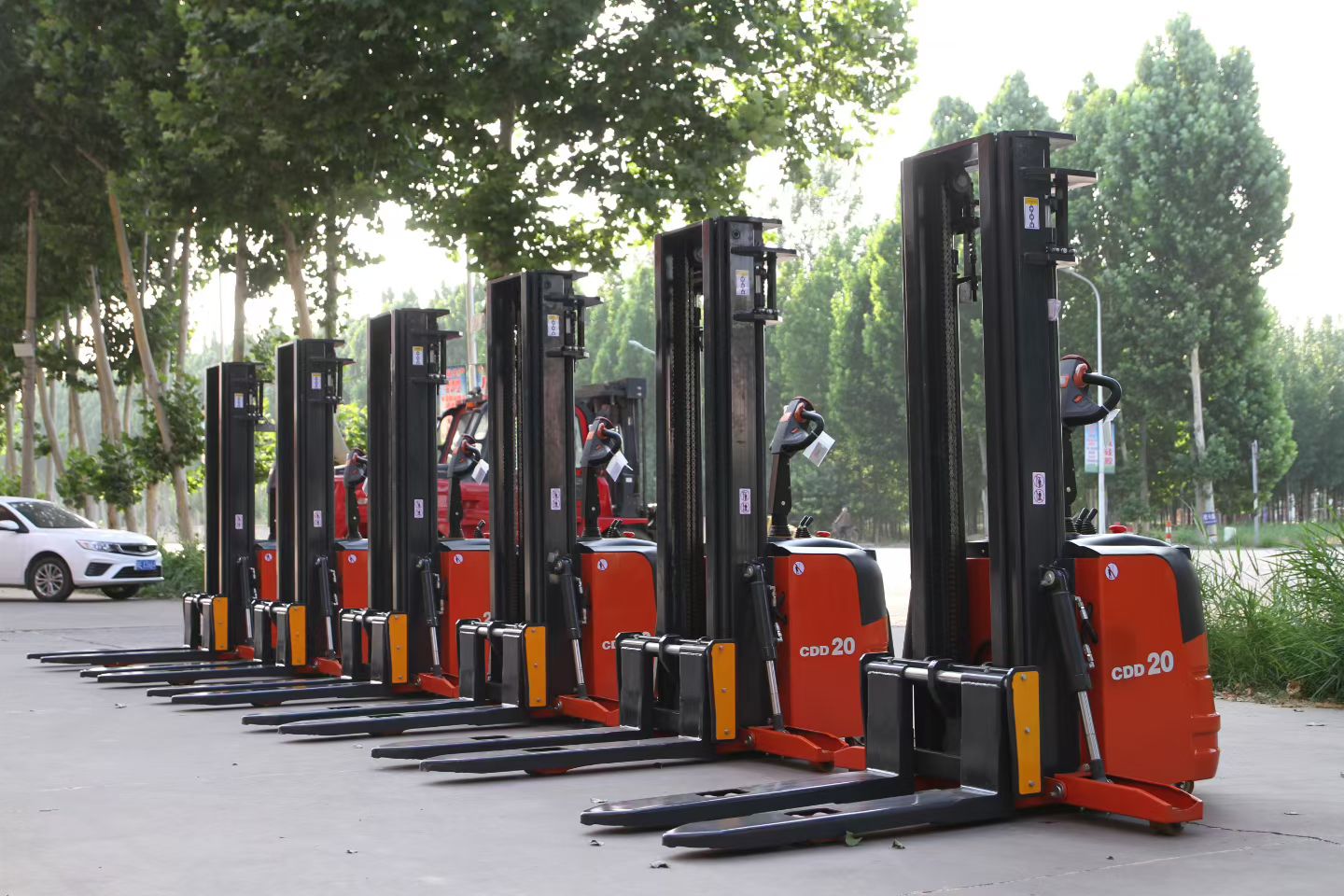
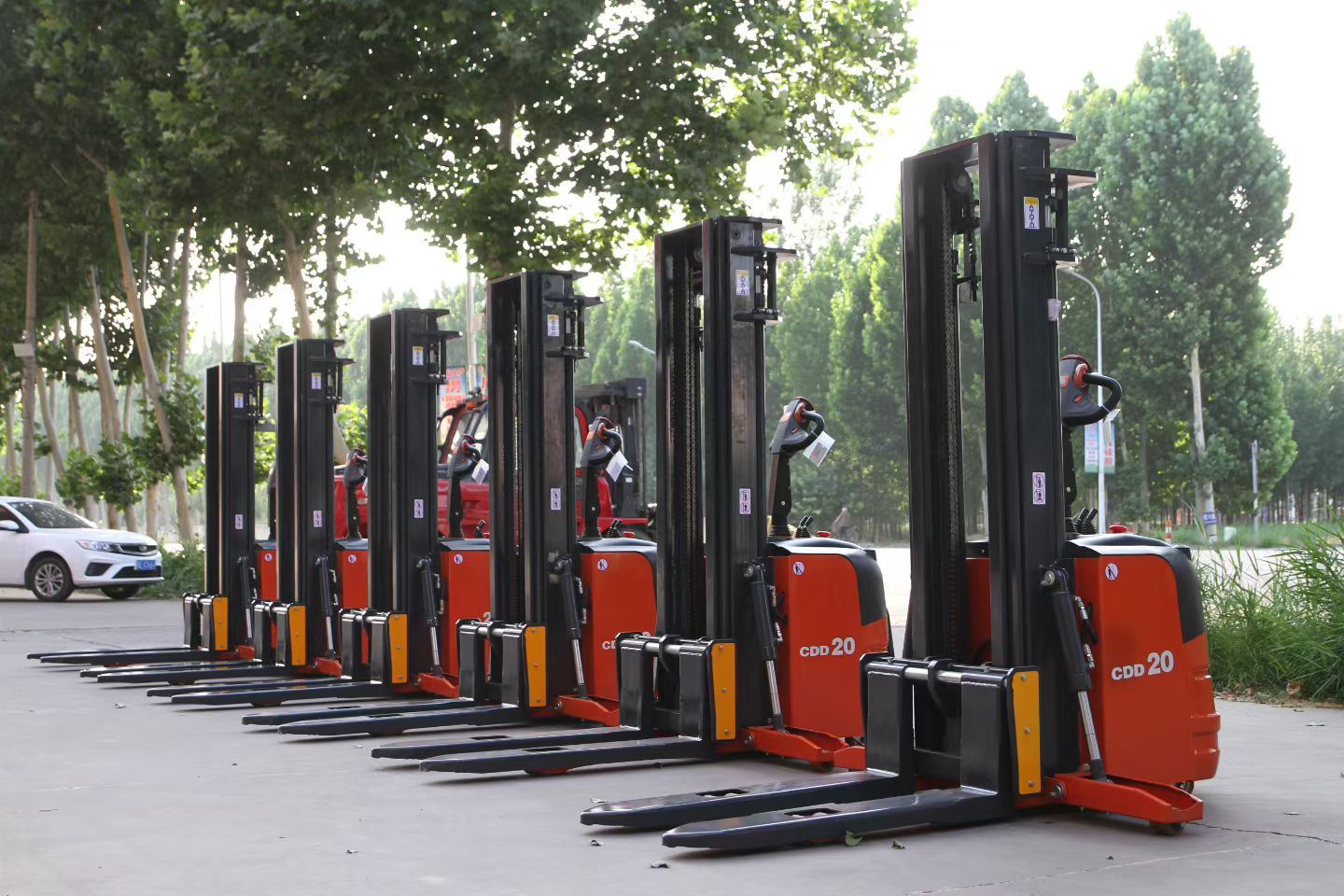
An electric stacker, also known as an electric pallet stacker, is a battery-run material handling machine built to lift, move and stack palletized cargo.
It sits somewhere between a pallet truck and a conventional forklift.
Unlike manual stackers, electric versions cut down the physical work needed to shift and raise loads. When compared against counterbalance forklifts, they tend to be smaller in size, making them a solid pick for warehouses tight on floor space.
Electric stackers are commonly used in:
l Warehouses
l Small factories
l Retail storage areas
l Distribution centers
l Logistics facilities
l Production lines
l Loading areas
They are particularly useful when the load is palletized and the operation does not require a full-size forklift.
The first number most buyers check is capacity.
Common electric stackers are available in capacities such as 1.0 ton, 1.2 ton, 1.5 ton, 1.6 ton, 2.0 ton and higher, depending on the design.
If your pallets normally weigh 800 kg, it may seem obvious that a 1 ton stacker is enough.
Do not decide too quickly.
Ask what the heaviest pallet weighs, not just the average.
A warehouse may normally handle 700–800 kg loads but receive 1,100 kg pallets several times per month. Buying around the average load can leave the machine unsuitable for part of the work.
It is also important to understand that rated capacity is based on specified operating conditions.
Lift height and load center can affect the actual capacity available.
When your operation runs near the machine’s rated capacity limit, share your actual load details with the supplier before finalizing the stacker model.
A 1.5 ton electric stacker with a 1,600 mm lift and another 1.5 ton model with a 3,500 mm lift are not solving the same problem.
Measure your warehouse racks.
Do not estimate.
If the highest pallet position is 3,000 mm, the stacker needs enough lift height to place and retrieve the load correctly.
At the same time, check the closed mast height.
This is often forgotten.
A warehouse may have a 3.5-meter rack but a lower doorway between working areas. A stacker that can reach the rack is not much use if its mast cannot pass through the door.
Before requesting a quotation, record:
Maximum required lift height
Lowest doorway or overhead restriction
Give both measurements to the supplier.
This is one of the main reasons companies choose an electric stacker instead of a conventional forklift.
Stackers can work in relatively compact areas.
But “narrow aisle” is not a useful measurement.
One buyer's narrow aisle may be 2.8 meters. Another may have only 2.1 meters.
Measure the actual space.
Consider not only aisle width but also the room available for turning into the rack position with a pallet on the forks.
Check the manufacturer's specification for turning radius and required stacking aisle width.
If space is tight, send a simple warehouse drawing with dimensions.
A few measurements can prevent an expensive mistake.
This is one of the most overlooked points when purchasing an electric stacker.
Not every pallet works equally well with every stacker design.
The position of the stacker's support legs and forks must be compatible with the pallet.
Before ordering, tell the supplier:
l Pallet length
l Pallet width
l Entry direction
l Bottom structure
l Whether the pallet is open or closed underneath
A standard European pallet and a custom industrial pallet may require different fork arrangements.
If you use several pallet types, mention all of them.
Sending a photograph with dimensions is often easier than trying to describe the pallet in an email.
Fork dimensions are closely related to pallet compatibility.
Forks that are too short fail to hold the pallet load securely.
Overly long forks, on the other hand, make it harder to navigate tight warehouse spaces.
Fork outside width also matters.
Some electric stackers use fixed forks. Other models may offer adjustable configurations depending on the design.
Do not assume that “standard forks” will fit your pallet.
Include pallet dimensions when requesting the machine.
This is an important decision for some warehouse operations.
A conventional electric stacker lifts one pallet load on the forks.
A double-lift electric stacker is designed for applications where additional pallet handling capability can improve transport efficiency, depending on the specific machine design and load arrangement.
This can be useful in operations where goods need to be moved repeatedly between storage, staging and loading areas.
However, a double-lift stacker should not be selected simply because “two pallets are better than one.”
Check:
l Individual pallet weight
l Total load
l Pallet dimensions
l Travel distance
l Required lift height
l Warehouse layout
Warehouses that mostly place one pallet onto racking per lift can opt for standard electric stackers. Such models are simpler and more cost-effective.
For sites with frequent pallet movement, a properly selected double-lift configuration can cut handling runs and is well worth considering.
Electric stackers are available with different operator arrangements.
A walkie electric stacker is controlled by an operator walking with the machine.
This can work well for shorter travel distances and smaller warehouses.
For longer routes, repeatedly walking behind a stacker can become inefficient.
A platform or ride-on configuration can make more sense where the operator moves goods over greater distances throughout the day.
Think about the actual route.
If the machine travels 10 meters between two rack positions, walking may be perfectly practical.
If it repeatedly travels 80 meters from receiving to storage, the answer may be different.
Distance matters.
A warehouse using a stacker for one hour each morning has very different requirements from a distribution operation using it throughout the day.
Tell the supplier:
How many hours per day will it operate?
Also explain whether the use is continuous or intermittent.
This information helps determine battery requirements.
It can also influence which model is suitable for the workload.
Do not automatically choose the cheapest stacker for intensive daily use.
A machine that works occasionally and a machine used continuously should not necessarily have the same specification.
Battery choice has become an important part of electric material handling equipment.
Lithium batteries can be attractive for warehouses that want faster charging, opportunity charging and lower routine battery maintenance.
They shine in operations where the stacker runs steadily all day, with spare time to top up power during work breaks.
Lead-acid batteries still fit certain scenarios well. This is especially true when buyers prioritize upfront cost and the equipment has sufficient idle time for standard charging cycles.
The correct choice depends on use.
A small warehouse operating a stacker for 60 minutes per day may not need the same battery solution as a busy logistics operation.
Instead of asking for the biggest battery, describe the working schedule.
Buyers sometimes spend a long time discussing the battery and almost no time discussing the charger.
The two belong together.
Check that the charger is matched to the battery configuration and suitable for the intended operating location.
If you are importing stackers for resale, confirm electrical requirements before shipment.
Also think about where customers will charge the machine.
Is there a convenient charging location?
Will the stacker need to be moved out of the working area?
Does the operation plan to charge overnight or during breaks?
These small operational questions affect whether the machine feels convenient after delivery.
Electric stackers work best when the machine and wheels are suited to the floor.
A smooth warehouse floor is straightforward.
Uneven surfaces, expansion joints, ramps and damaged concrete can change the operating experience significantly.
Before ordering, consider:
l Floor smoothness
l Slopes
l Door thresholds
l Loading dock transitions
l Indoor/outdoor movement
Some stackers are designed mainly for indoor warehouse use.
If the machine must regularly cross rough outdoor ground, tell the supplier.
Do not assume a stacker that performs well on polished concrete will behave the same way everywhere.
A small ramp can be a big issue when a stacker is carrying a heavy pallet.
If your warehouse has slopes, measure them and discuss the application with the manufacturer.
The machine's gradeability and braking characteristics should be suitable for the working environment.
Also consider what happens when the stacker is loaded.
An empty machine climbing a ramp in a demonstration video tells you very little about how it will behave with the customer's normal load.
A specification sheet cannot tell you whether a machine is comfortable to use.
Look at the control handle.
Are the lift and lower buttons easy to reach?
Is direction control intuitive?
Is the emergency reverse function positioned properly?
Can the operator control the machine without awkward hand movements?
If possible, test the stacker before placing a large order.
For distributors, let a technician or experienced warehouse operator try it.
They often notice things a purchasing manager does not.
Safety features are most useful when they work naturally with the operator.
Depending on the stacker design, this may include emergency reverse protection, braking functions, speed control, operator-presence functions and controlled lifting or lowering.
Visibility matters too.
The operator should have a clear view of the travel direction and load.
Warehouse managers should also consider pedestrian traffic.
A compact electric stacker may be smaller than a forklift, but it is still powered material handling equipment carrying a substantial load.
Operator training and safe warehouse procedures remain essential.
Electric equipment generally has fewer routine engine-related service requirements than internal combustion equipment, but that does not mean maintenance disappears.
Wheels wear.
Hydraulic seals age.
Switches and sensors can fail.
Batteries and chargers need to remain in good condition.
Before purchasing, ask:
Which parts require regular inspection?
Which parts normally wear first?
Can common spare parts be supplied with the machine?
For a distributor, these questions are particularly important.
Your customer will call you first when the stacker needs service.
A low purchase price can quickly lose its advantage if a small replacement part is difficult to obtain.
Ask for a spare-parts list.
For commercial fleets or distributor orders, consider keeping common wear and service parts locally.
Also check how the supplier identifies parts later.
If you send the model number, serial number and a photo two years after purchase, can the factory identify the correct component?
This is a much better test of long-term support than simply asking:
“Do you have after-sales service?”
Almost every supplier will answer yes.
An electric stacker is not automatically a cheaper replacement for a forklift.
They serve overlapping but different applications.
A stacker can be a strong choice when:
l Warehouse space is limited
l Loads are palletized
l Travel distances are relatively short
l Required capacity is moderate
l Indoor stacking is the main task
l A full counterbalanced forklift is unnecessary
A conventional electric forklift may be better when the operation involves heavier loads, longer travel distances, frequent loading and unloading, varied pallet types or more demanding working conditions.
In some cases, combining both types of equipment is the right approach.
One typical warehouse setup uses forklifts for truck unloading, while electric stackers handle goods transport between racking.
Your equipment selection should match site requirements, rather than simply picking the cheaper machine.
If you want an accurate electric stacker recommendation, send more than a requested capacity.
A useful inquiry looks something like this:
Maximum load: 1,500 kg
Pallet: 1,200 × 800 mm
Maximum lift height: 3,000 mm
Aisle width: 2,500 mm
Working time: 5 hours/day
Environment: Indoor warehouse
Travel distance: Approximately 30 m per trip
Battery preference: Lithium
Special requirement: Side movement not required
With this information, a supplier can recommend something meaningful.
Compare that with:
“Please quote your best price for 1.5 ton stacker.”
The second inquiry may get you a faster quotation.
The first is more likely to get you the right machine.
For distributors, the purchasing decision is slightly different.
You need to think about more than one warehouse.
Look at the applications that appear repeatedly in your market and build your product range around them.
A practical electric stacker range might include different capacities and lifting configurations rather than dozens of very similar models.
You can then offer additional battery, mast or fork options for specific customers.
This keeps inventory manageable while still giving your sales team enough flexibility.
For European and international distributors, it is also worth checking documentation, spare-parts support, product consistency and OEM possibilities before adding a stacker to your catalogue.
The easiest machine to buy is not always the easiest machine to support.
At EIOUU, we manufacture electric material handling equipment for international B2B customers, including distributors, wholesalers, importers, warehouses and industrial buyers.
Our electric stacker solutions are designed for different material handling requirements, including various load capacities and lifting applications.
Depending on the model and project, customers can discuss configurations such as:
l Load capacity
l Lift height
l Battery
l Fork dimensions
l Single or double lift
l Operator configuration
l Branding
l Other application requirements
For distributors developing their own product range, OEM & ODM cooperation can also be discussed according to the model, quantity and required customization.
We recommend choosing the machine from the application backwards.
Tell us the pallet weight, required lift height, space available for operators and daily running hours of the stacker.
Those four pieces of information are usually more useful than starting with a model number.
The best electric stacker is not necessarily the one with the largest battery, highest mast or longest list of features.
It is the one that fits the warehouse.
Start with the load.
Then measure the pallet.
Measure the rack.
Measure the aisle.
Look at the travel distance and daily working time.
After that, compare battery, controls, maintenance and supplier support.
It takes a little longer than choosing from a catalogue.
But an electric stacker may be used thousands of times during its working life.
Spending an extra half hour measuring the warehouse before ordering is usually a good investment.
Start with your maximum load weight, required lift height, pallet dimensions and aisle width. Do not select capacity based only on the average pallet weight.
A 1.5 ton stacker can suit many warehouse applications where loads remain within the machine's rated capacity. Actual suitability also depends on load center, lift height, pallet type and operating conditions.
Measure the highest rack position the machine needs to serve and check the required fork height. Also measure low doorways and overhead restrictions so the mast can move throughout the working area.
Many electric stackers can work with common pallet sizes, but compatibility depends on fork and support-leg design. Always provide the pallet dimensions and underside structure before ordering.
Lithium is attractive for frequent use, faster charging and lower routine battery maintenance. Lead-acid types still make sense for light workloads, when keeping the initial investment down is the top concern.
A double-lift stacker provides an additional lifting arrangement designed for specific pallet handling applications. Suitability depends on pallet weight, dimensions, travel requirements and the particular stacker design.
No single machine wins for all scenarios. Electric stackers suit indoor pallet work in narrow areas. Electric forklifts deliver more flexibility for heavy loads, longer runs and harder operating conditions.
Depending on the manufacturer and model, OEM options may include branding, battery configurations, lift heights, forks and other specifications. The available customization should be confirmed according to order quantity and technical requirements.
 Previous: None
How to Choose an Electric Stacker for Your Warehouse
Published on Oct. 01, 2026
Electric Forklift OEM & ODM Guide for European Distributors
Published on Sep. 29, 2026


314, Building 3, No. 12 Haitai Development 2nd Road, Binhai High-tech Zone, Xiqing District, Tianjin, China


Copyright © Tianjin HRX Technology Co., Ltd. All Rights Reserved. Sitemap
Home ProductsAbout usOEM/ODMNewsContact Us